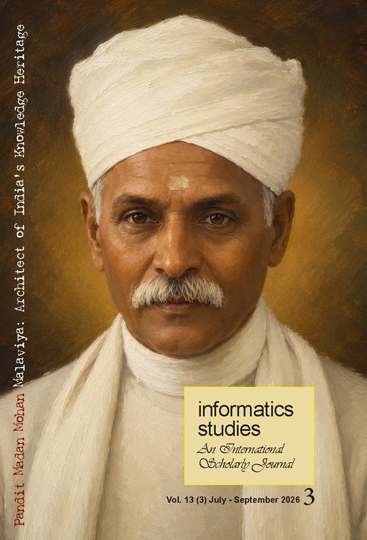
Pandit Madan Mohan Malaviya: Architect of India's National Education and Knowledge Heritage Management
Abstract
More than a century after the establishment of Banaras Hindu University (BHU), the vision of its founder, Mahamana Pandit Madan Mohan Malaviya, continues to illuminate the philosophy of higher education in India. Revered as an educationist, nationalist, institution builder, and social reformer, Malaviya envisioned a university where India's ancient intellectual heritage would coexist harmoniously with modern scientific knowledge, nurturing not only scholarship but also character, patriotism, and public service. This article explores his life, educational ideals, and the enduring legacy of BHU as a living embodiment of that vision. It examines how Malaviya integrated cultural preservation, knowledge creation, libraries, and national development into a holistic model of higher education whose relevance extends far beyond its historical context. At a time when universities are redefining their roles within digital knowledge ecosystems and global networks, Malaviya's philosophy offers enduring insights into the purpose of education and nation building.References
Aggarwal, J C (2009). Development and Planning of Modern Education. New Delhi: Vikas Publishing House.
Banaras Hindu University (2016). Banaras Hindu University: A Century of Service to the Nation. Varanasi: Banaras Hindu University.
Basu, A (1974). The Growth of Education and Political Development in India, 1898–1920. Delhi: Oxford University Press.
Chathurvedi, Sri Ram (2014). Madhan Mohan Malavya (Builders of Modern India). New Delhi, Publications Division, Govt of India, 2024
Chowdhury K; Datta, N and Nathani N (2022). Mahamana Malaviya Ji: A Great Visionary for Ayurvedic Education." Journal of Ayurveda and Integrated Medical Sciences, 7(12), December, 2022.
Dwivedi, Krishna Datt (1979). Punarjagaran evam Parivartan ke Sandarbh mein Madan Mohan Malaviya ke Samajik Vicharon ka Adhyayan. Guide: Surendra Kumar Shrivastava. Dept: Samaj Vigyan Vibhag, Kashi Hindu Vi.Vi.Varanasi.
Gireesh Kumar, T K (2020). Heritage Information System of Banaras for Conservation and Sustainable Development. Research Project under the programme: Institution of Eminence, BHU.
Gupta, S L (1978). Pandit Madan Mohan Malaviya: A Socio-Political Study. Allahabad: Chugh Publications.
Mahamana Malavya Mission (2026). Pandit Madan Mohan Malaviya Home Page. https://malaviyamission.org/index.php
Maini, S K; Vishvanath Pandey; Chandra Mouli, K (2012). Madan Mohan Malaviya: Visionery of Modern India. new Delhi, Roli Books.
Malaviya, M M (1911). The Prospectus of the Hindu University. Allahabad: Indian Press.
Parmanand (1985). Mahamana Madan Mohan Malaviya: An Historical Biography. Varanasi: Malaviya Adhyayan Sansthan, Banaras Hindu University.
Pravish Prakash and V Jain, Vivekanand (2006): Sayaji Rao Gaekwad Library, Banaras Hindu University: The pride of Kashi. Prajna: Journal of the Banaras Hindu University (Kashi-Gaurav Visheshank-1) 52(1-2) 2006-07
Rai Markandeya (1986). Madan Mohan Malaviya ke Shaikshik Vicharon ka Adhyayan. Guide: T. Singh. Dept: Darshan evam Dharma Vigyan Vibhag, Kashi Hindu Vi.Vi. Varanasi.
Raman Nair, R and Jayapradeep, M (Conserving the Cultural heritage of Banaras: Application of Information and Communication Technology. In: Knowledge management: Library and Information Services in Changing IT Scenario. (Festschrift Volume in Honour of Prof. Y. P Dubey). Ed by J L Upadhay. Znew Delhi, Shree Publishers,
Shrivastava, Annapurna (1992). Mahamana Malaviya evam Dr. Bhagwan Das ke Samaj Darshan ka Adhyayan. Guide: Umesh Chandra Dubey. Dept: Darshan evam Dharma Vigyan Vibhag, Kashi Hindu Vi.Vi. Varanasi.
Singh, Devendra Pratap (1989). Beesvin Sadi mein Samajik Chetana – 1947 tak: Malaviya va Gandhi ke Vishesh Sandarbh mein. Guide: K. S. Shanta. Dept: Itihas Vibhag, Kashi Hindu Vi.Vi.Varanasi.
Singh, N L (Ed.) (1962). Mahamana Malaviyaji Birth Centenary Commemoration Volume. Varanasi: Banaras Hindu University.
Singh, Swarna Lata (1992). Pandit Mahamana ka Hindi mein Yogdan. Guide: Surya Narayan Dwivedi. Department: Hindi Vibhag, Kashi Hindu Vi.Vi. Varanasi.
Srivastava, A K; Vivekanand Jain and S. Saraf, S (2013). Mahamana Digital Library. Prajna. Mahamana Malaviya Jayanti Visheshank. 58(2) 2012-2013. Pp. 230-235.
Subhash Chandra(2008). Mahamana Pt. Madan Mohan Malaviya aur Hindu Dharma. Guide. D A Gangadhar, D A. Dept: Darshan evam Dharma Vigyan Vibhag, Varanasi, BHU.
UNESCO (2003). Convention for the Safeguarding of the Intangible Cultural Heritage. Paris: UNESCO.
UNESCO (2015). Recommendation Concerning the Preservation of, and Access to, Documentary Heritage Including in Digital Form. Paris: UNESCO.
Vivekanand Jain (2020). Research on Pandit Madan Mohan Malaviya’s Life and contributions in Banaras Hindu University. (Unpublished manuscripts / Presentations)
Vivekanand, Jain (2019). Sayajirao Gaikwad Library, Kashi Hindu University ke Unnayankarta Pramukh Librarian (Hindi). (Librarians who developed the Sayaji Rao Gaekwad Library, Banaras Hindu University). Granthalaya Vigyan, 50, 2019. pp.176-180.
Downloads
Published
Issue
Section
License
Submission of a manuscript to IS indicates that the work is original, has not been previously published (except as an abstract, lecture, or thesis), and is not under consideration by another journal. By submitting, authors affirm that their manuscript meets the journal’s ethical and editorial standards and that they agree to the terms of copyright and licensing upon acceptance.
Once accepted for publication, authors grant IS the first publication rights to the work. However, authors retain full copyright of their content and remain the legal owners of their intellectual property.
IS provides open access to all published articles six months after the release of the respective volume. Once the embargo period concludes, articles are made freely available under the Creative Commons Attribution (CC BY) License (https://creativecommons.org/licenses/by/4.0/). This license allows users to share, adapt, and reuse the work in any medium or format provided that appropriate credit is given to the original authors and the initial publication in this journal.
The journal's delayed open access model supports global knowledge dissemination, ensuring that research is accessible without financial or legal barriers. Authors are also encouraged to archive their published articles in institutional repositories, personal websites, or other platforms, with full citation of the journal version. Pre-print versions posted online should include a citation and link to the final published version in IS as soon as the issue is available; post-print versions (including the final publisher's PDF) should include a citation and link to the journal's website.
All materials published in the IS website are distributed under a Creative Commons Attribution license, unless otherwise noted.