Knowledge Management and the Enduring Vision of Madan Mohan Malaviya
Keywords:
Knowledge Management, Universities, Libraries, Banaras Hindu University, Information SystemsAbstract
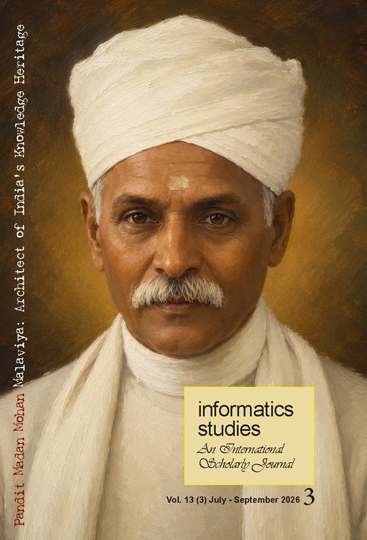
Examines the growing importance of knowledge management in higher education and reinterprets the educational philosophy of Pandit Madan Mohan Malaviya in the context of contemporary digital knowledge ecosystems. As universities evolve from centres of teaching into integrated knowledge organizations, university libraries have emerged as strategic infrastructures supporting digital scholarship, artificial intelligence, research data management, institutional repositories, open science, and knowledge preservation. The lead papers in this volume argues that Malaviya's vision of Banaras Hindu University anticipated many of the principles underlying modern knowledge management by integrating India's intellectual heritage, scientific inquiry, libraries, ethical education, and national development within a unified institutional framework. The contributions to this special issue, highlights emerging perspectives on digital knowledge infrastructure, climate knowledge, educational networking, professional development, and artificial intelligence in universities. The editorial concludes that effective knowledge management, grounded in enduring educational values and strengthened by technological innovation, is indispensable for building resilient, inclusive, and knowledge-driven universities in the twenty-first century.
Downloads
Published
Issue
Section
License
Submission of a manuscript to IS indicates that the work is original, has not been previously published (except as an abstract, lecture, or thesis), and is not under consideration by another journal. By submitting, authors affirm that their manuscript meets the journal’s ethical and editorial standards and that they agree to the terms of copyright and licensing upon acceptance.
Once accepted for publication, authors grant IS the first publication rights to the work. However, authors retain full copyright of their content and remain the legal owners of their intellectual property.
IS provides open access to all published articles six months after the release of the respective volume. Once the embargo period concludes, articles are made freely available under the Creative Commons Attribution (CC BY) License (https://creativecommons.org/licenses/by/4.0/). This license allows users to share, adapt, and reuse the work in any medium or format provided that appropriate credit is given to the original authors and the initial publication in this journal.
The journal's delayed open access model supports global knowledge dissemination, ensuring that research is accessible without financial or legal barriers. Authors are also encouraged to archive their published articles in institutional repositories, personal websites, or other platforms, with full citation of the journal version. Pre-print versions posted online should include a citation and link to the final published version in IS as soon as the issue is available; post-print versions (including the final publisher's PDF) should include a citation and link to the journal's website.
All materials published in the IS website are distributed under a Creative Commons Attribution license, unless otherwise noted.