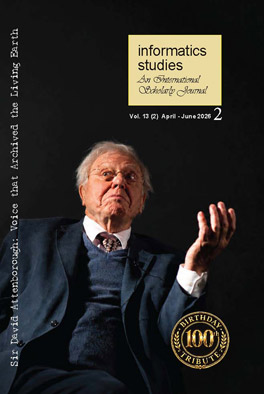
The Voice that Archived the Living Earth: A Tribute to Sir David Attenborough
Keywords:
David Attenborough, Documentation, Environment, Communication, Ecology, Natural History, Biodiversity, Conservation, Education, Knowledge Management, Planetary Stewardship, Climate Change, Awareness, Living Planet, Literacy, Anthropocene.Abstract
The present issue of Informatics Studies commemorates the centenary of Sir David Attenborough by examining the enduring significance of his contributions to environmental communication, biodiversity documentation, and public ecological awareness. The papers included reflect on Attenborough’s unique role as a witness to, and interpreter of, one of the most transformative periods in planetary history, during which humanity’s impact on natural systems became increasingly evident. The authors argue that his documentaries, writings, and public interventions collectively constitute an unparalleled archive of ecological memory, preserving invaluable records of species, habitats, and environmental change. Beyond natural history broadcasting, Attenborough’s work is considered within broader contexts of environmental education, knowledge preservation, sustainability discourse, and public engagement with science. The studies further highlight the relevance of his legacy in addressing contemporary challenges such as biodiversity loss, climate change, and ecological degradation. Editors position this commemorative volume as both a tribute to Attenborough’s achievements and a reflection on humanity’s shared responsibility for safeguarding the living planet for future generations.
References
Attenborough, David (1979). Life on Earth: A Natural History. London, London, Willam Collins and BBC.
Attenborough, David (2002). Life on Air: Memoirs of a Broadcaster. London, BBC Books.
Attenborough, David (2006). Climate Change is the Major Challenge Facing the World. London, The Independent. 24 May 2006.
Attenborough, D., & Hughes, J. (2020). A Life on Our Planet: My Witness Statement and a Vision for the Future. Ebury Publishing.
Downloads
Published
Issue
Section
License
Submission of a manuscript to IS indicates that the work is original, has not been previously published (except as an abstract, lecture, or thesis), and is not under consideration by another journal. By submitting, authors affirm that their manuscript meets the journal’s ethical and editorial standards and that they agree to the terms of copyright and licensing upon acceptance.
Once accepted for publication, authors grant IS the first publication rights to the work. However, authors retain full copyright of their content and remain the legal owners of their intellectual property.
IS provides open access to all published articles six months after the release of the respective volume. Once the embargo period concludes, articles are made freely available under the Creative Commons Attribution (CC BY) License (https://creativecommons.org/licenses/by/4.0/). This license allows users to share, adapt, and reuse the work in any medium or format provided that appropriate credit is given to the original authors and the initial publication in this journal.
The journal's delayed open access model supports global knowledge dissemination, ensuring that research is accessible without financial or legal barriers. Authors are also encouraged to archive their published articles in institutional repositories, personal websites, or other platforms, with full citation of the journal version. Pre-print versions posted online should include a citation and link to the final published version in IS as soon as the issue is available; post-print versions (including the final publisher's PDF) should include a citation and link to the journal's website.
All materials published in the IS website are distributed under a Creative Commons Attribution license, unless otherwise noted.