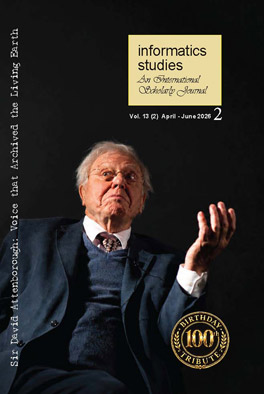
David Attenborough and the Classroom Without Walls
Keywords:
Ecology, Conservation, Environment, Biodiversity, Education, Children, Awareness. Open Access.Abstract
The author explores the profound impact of Sir David Attenborough’s life work on global environmental literacy and emotional connectivity to nature. By leveraging multimedia storytelling, Attenborough has bridged the gap between humanity and distant ecosystems, nurturing ‘naturalistic intelligence’ in ways traditional textbooks cannot. The author highlights the transformative power of his documentaries in fostering curiosity, empathy, and conservation values in children. However, the author identifies a critical barrier: the commercial and legal restrictions limiting access to these resources in underfunded schools and developing regions. Proposing a collaborative model between governments and international agencies like UNESCO, the author advocates for open-access digital repositories to democratise environmental education. Ultimately, it is argued that ensuring universal access to Attenborough’s archive is essential for cultivating an informed global citizenry capable of addressing urgent ecological crises.
References
Asheela Sierra (2025). David Attenbborough: Life and Legacy. In PBS. https://www.pbs.org/articles/david-attenborough-life-and-legacy
Attenborough, David, and Jonnie Hughes (2020). A Life on Our Planet: My Witness Statement and a Vision for the Future. London: Ebury Publishing.
Attenborough, David. (2002). Life on Air: Memoirs of a Broadcaster. London: BBC Books. Bharti, P K (2016). Biodiversity, Biotechnology and Environmental Conservation. New Delhi, India: Discovery Publishing House Pvt. Ltd.
Bodzin, A M, Klein, B S, & Weaver, S (Eds) (2010). The Inclusion of Environmental Education in Science Teacher Education. Dordrecht, Netherlands: Springer.
Castro, P, Azeiteiro, U M, Bacelar-Nicolau, P, Leal Filho, W, & Azul, A M (Eds). (2016). Biodiversity and Education for Sustainable Development. Cham, Switzerland: Springer.
Environmental Literacy Council & National Science Teachers Association (2007). Biodiversity: Resources for Environmental Literacy. Arlington, VA, USA: NSTA Press.
Fraser, N (2014). The Environmental Toolkit for Teachers: First Steps to Sustainability. London, United Kingdom: Bloomsbury Education.
Hungerford, H R, Bluhm, W J, Volk, T L, & Ramsey, J M (2006). Essential Readings in Environmental Education. Champaign, IL, USA: Stipes Publishing.
Jacobson, S K, McDuff, M D, & Monroe, M C (2015). Conservation Education and Outreach Techniques (2nd ed). Oxford, United Kingdom: Oxford University Press.
Monroe, M C, Andrews, E, & Biedenweg, K (2008). A Framework for Environmental Education Strategies. Gainesville, FL, USA: North American Association for Environmental Education (NAAEE).
Pachauri, S (2012). Environmental Education. New Delhi, India: Pearson Education India.
Shimray, C (2026). Environmentalizing Education: Reorienting Teachers’ Perspectives. London, United Kingdom: Routledge.
Downloads
Published
Issue
Section
License
Submission of a manuscript to IS indicates that the work is original, has not been previously published (except as an abstract, lecture, or thesis), and is not under consideration by another journal. By submitting, authors affirm that their manuscript meets the journal’s ethical and editorial standards and that they agree to the terms of copyright and licensing upon acceptance.
Once accepted for publication, authors grant IS the first publication rights to the work. However, authors retain full copyright of their content and remain the legal owners of their intellectual property.
IS provides open access to all published articles six months after the release of the respective volume. Once the embargo period concludes, articles are made freely available under the Creative Commons Attribution (CC BY) License (https://creativecommons.org/licenses/by/4.0/). This license allows users to share, adapt, and reuse the work in any medium or format provided that appropriate credit is given to the original authors and the initial publication in this journal.
The journal's delayed open access model supports global knowledge dissemination, ensuring that research is accessible without financial or legal barriers. Authors are also encouraged to archive their published articles in institutional repositories, personal websites, or other platforms, with full citation of the journal version. Pre-print versions posted online should include a citation and link to the final published version in IS as soon as the issue is available; post-print versions (including the final publisher's PDF) should include a citation and link to the journal's website.
All materials published in the IS website are distributed under a Creative Commons Attribution license, unless otherwise noted.