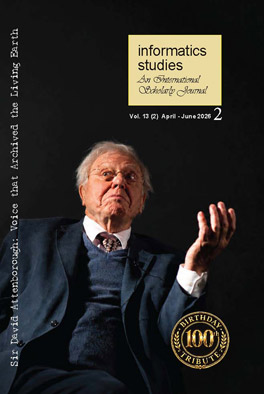
The Mahatma of Global Environmentalism: A Personal Tribute to Sir David Attenborough
Keywords:
Sir David Attenborough, Natural History, Environmentalism, Biodiversity Conservation, Ecological Consciousness, Nature Writing, Environmental Communication, Wildlife Documentary, Climate Change Advocacy, Conservation Ethics, Environmental EducaAbstract
This tribute reflects on the profound influence of Sir David Attenborough on generations of naturalists, environmentalists, and nature enthusiasts across the world. Drawing upon personal memories from Kerala, Prof. Murali M. Sivaramakrishnan recounts how Attenborough's documentaries and writings nurtured a lifelong fascination with biodiversity and ecological interconnectedness. The essay situates Attenborough not merely as a broadcaster and natural historian, but as a visionary communicator who transformed public understanding of nature through a rare blend of scientific insight, storytelling, humility, and hope. It highlights his contribution to global environmental awareness, particularly his efforts to communicate the urgency of climate change, biodiversity loss, and ecological stewardship. Interweaving personal experience with environmental reflection, the tribute portrays Attenborough as a bridge between science and society, wonder and responsibility, and generations of environmental thinkers. Ultimately, it celebrates his enduring legacy as an educator, conservation advocate, and moral voice whose work continues to inspire care for the living planet.
References
Attenborough, D (1979). Life on Earth: A Natural History. London: Collins.
Attenborough, D (1984). The Living Planet. London: Collins.
Attenborough, D (1990). The Trials of Life: A Natural History of Animal Behaviour. London: Collins.
Attenborough, D (2000). The Blue Planet: A Natural History of the Oceans. London: BBC Worldwide.
Attenborough, D (2006). Planet Earth: The Future. London: BBC Books.
Attenborough, D (2010). Frozen Planet. London: HarperCollins.
Attenborough, D (2020). A Life on Our Planet: My Witness Statement and a Vision for the Future. London: Ebury Publishing.
Downloads
Published
Issue
Section
License
Submission of a manuscript to IS indicates that the work is original, has not been previously published (except as an abstract, lecture, or thesis), and is not under consideration by another journal. By submitting, authors affirm that their manuscript meets the journal’s ethical and editorial standards and that they agree to the terms of copyright and licensing upon acceptance.
Once accepted for publication, authors grant IS the first publication rights to the work. However, authors retain full copyright of their content and remain the legal owners of their intellectual property.
IS provides open access to all published articles six months after the release of the respective volume. Once the embargo period concludes, articles are made freely available under the Creative Commons Attribution (CC BY) License (https://creativecommons.org/licenses/by/4.0/). This license allows users to share, adapt, and reuse the work in any medium or format provided that appropriate credit is given to the original authors and the initial publication in this journal.
The journal's delayed open access model supports global knowledge dissemination, ensuring that research is accessible without financial or legal barriers. Authors are also encouraged to archive their published articles in institutional repositories, personal websites, or other platforms, with full citation of the journal version. Pre-print versions posted online should include a citation and link to the final published version in IS as soon as the issue is available; post-print versions (including the final publisher's PDF) should include a citation and link to the journal's website.
All materials published in the IS website are distributed under a Creative Commons Attribution license, unless otherwise noted.