Documenting the Anthropocene: Connecting Attenborough’s Environmental Heritage with Global Open Knowledge Systems
Keywords:
Global Green Librarianship, Information Ecology, Open Science Infrastructures, IFLA 2030 Agenda, Agentic AI, Retrieval-Augmented Generation (RAG), David Attenborough, Biodiversity, Conservation, Environmental Informatics, Knowledge management (KM).Abstract
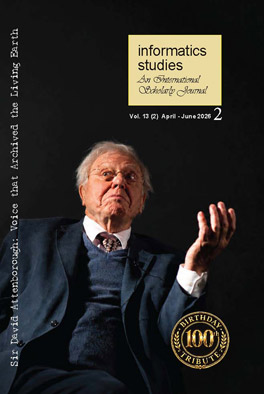
As Sir David Attenborough reaches his centenary, his unparalleled natural history corpus constitutes one of the world’s richest repositories of biodiversity knowledge and ecological memory. Yet, despite its immense educational and scientific value, this vast documentation remains largely confined to commercial broadcasting platforms, with limited integration into academic discovery systems, research infrastructures, and Open Science environments. The author examines the growing disconnect between peer-reviewed environmental knowledge preserved in open-access repositories and Attenborough’s documentation of global biodiversity. Drawing on concepts from information ecology, knowledge organization, green librarianship, and the IFLA 2030. It is the absence of semantic, metadata, and discovery-layer integration that limits the scholarly and public use of this unique knowledge resource. The author proposes strategies for preserving, organizing, and enhancing the discoverability of Attenborough’s corpus, including the development of an AI-enabled Attenborough-LLM, thereby transforming a globally significant environmental heritage into an accessible resource for biodiversity research, education, conservation, and ecological literacy.
References
Alperin, Juan Pablo, et al. (2024). Global Open Access Dynamics: Regional Infrastructures and Institutional Mandates in the Global South. Vancouver, Public Knowledge Project.
Babini, Dominique (2020). Toward a global open access scholarly communications system – a developing region perspective. In: Eve, Martin Paul and Jonathan Gray (eds.). Reassembling Scholarly Communications: Histories, Infrastructures, and Global Politics of Open Access. Cambridge, MA, MIT Press, pp. 319–330. http://eprints.rclis.org/40954/
Bailund, Allison, Deborah Tomaras, Michelle Cronquist and Tina Gross (2026). Seeking Approval, Confronting Objectivity: Neutrality in the Library of Congress Subject Headings Approval Process. In the Library with the Lead Pipe, 18 March 2026. https://www.inthelibrarywiththeleadpipe.org/2026/seeking-approval/
Berman, Sanford (1971). Prejudices and Antipathies: A Tract on the LC Subject Heads Concerning People. Metuchen, NJ, Scarecrow Press. https://archive.org/details/prejudicesantipa0000berm
CETAF (2025). Consortium of European Taxonomic Facilities: European taxonomic infrastructure and biodiversity data standards. Brussels, CETAF Secretariat. https://cetaf.org/
cOAlition S (2021). Plan S: Making Full and Immediate Open Access a Reality. https://www.coalition-s.org/
Crutzen, Paul J. (2002). Geology of mankind. Nature, 415 (6867). https://www.nature.com/articles/415023a
Dada, Kayode Sunday John and Aminu Umar Musa (2026). Libraries and Open Climate Knowledge: Informatics Approaches to Climate Solutions and Disaster Preparedness. Informatics Studies, 13 (2).
Dublin Core Metadata Initiative (2020). DCMI Metadata Terms. https://www.dublincore.org/specifications/dublin-core/dcmi-terms/
EOSC Association (2023). European Open Science Cloud Strategic Research and Innovation Agenda. Brussels, EOSC. https://research-and-innovation.ec.europa.eu/strategy/strategy-research-and-innovation/our-digital-future/open-science/european-open-science-cloud-eosc_en
ESFRI (2026). Strategy Working Group on Environment: Strategic European Research Infrastructures. European Strategy Forum on Research Infrastructures. https://www.esfri.eu/environment
European Commission (2025). Environmental Sciences and Knowledge Policy Framework. Brussels, European Union. https://environment.ec.europa.eu/index_en
Europeana (2024). Europeana Strategy 2020-2025: Empowering cultural heritage institutions in their digital transformation. The Hague, Europeana Foundation. https://www.europeana.eu/
GBIF (2026). Global Biodiversity Information Facility: Data infrastructure for global biodiversity monitoring. Copenhagen, GBIF Secretariat. https://www.gbif.org/
Hauke, Petra, Karen Latimer and Klaus Ulrich Werner (eds.) (2013). The Green Library = Die grüne Bibliothek: The challenge of environmental sustainability. Berlin, De Gruyter Saur (IFLA Publications, 160).
IFLA (2019). Libraries and the Sustainable Development Goals: A handbook for cross-border advocacy and the UN 2030 Agenda. The Hague, International Federation of Library Associations and Institutions.
Lovelock, James (1979). Gaia: A New Look at Life on Earth. Oxford, Oxford University Press. https://archive.org/details/gaianewlookatlif00loverich/page/n5/mode/2up
Nardi, Bonnie A. and Vicki L. O'Day (1999). Information Ecologies: Using Technology with Heart - Chapter Four: Information Ecologies. First Monday, 4 (5). https://firstmonday.org/ojs/index.php/fm/article/view/672/582
Olson, Hope A. (2002). The Power to Name: Locating the Other in Library Classification. Dordrecht, Kluwer Academic Publishers. https://archive.org/details/powertonamelocat0000olso/page/n3/mode/2up
PREMIS Editorial Committee (2015). PREMIS Data Dictionary for Preservation Metadata, Version 3.0. Washington, Library of Congress. https://www.loc.gov/standards/premis/v3/
Prasad, A. and Joanna Thomas (2026). Curating the Living Planet: David Attenborough and the Informatics of Biodiversity Knowledge. Informatics Studies, 13 (2).
Royal Albert Hall (2026). David Attenborough's 100 Years on Planet Earth: A Centenary Tribute. London, RAH Archive. https://www.royalalberthall.com/tickets/events/2026/david-attenboroughs-100-years-on-planet-earth
Wildscreen (2018). The ARKive Project: Chronicling Life on Earth. Bristol, Wildscreen Archive. https://www.wildscreen.org/
Wikipedia (2026). David Attenborough. Wikipedia, The Free Encyclopedia. https://en.wikipedia.org/wiki/David_Attenborough
Winner, Langdon (1980). Do Artifacts Have Politics? Daedalus, 109 (1). https://faculty.cc.gatech.edu/~beki/cs4001/Winner.pdf
Downloads
Published
Issue
Section
License
Submission of a manuscript to IS indicates that the work is original, has not been previously published (except as an abstract, lecture, or thesis), and is not under consideration by another journal. By submitting, authors affirm that their manuscript meets the journal’s ethical and editorial standards and that they agree to the terms of copyright and licensing upon acceptance.
Once accepted for publication, authors grant IS the first publication rights to the work. However, authors retain full copyright of their content and remain the legal owners of their intellectual property.
IS provides open access to all published articles six months after the release of the respective volume. Once the embargo period concludes, articles are made freely available under the Creative Commons Attribution (CC BY) License (https://creativecommons.org/licenses/by/4.0/). This license allows users to share, adapt, and reuse the work in any medium or format provided that appropriate credit is given to the original authors and the initial publication in this journal.
The journal's delayed open access model supports global knowledge dissemination, ensuring that research is accessible without financial or legal barriers. Authors are also encouraged to archive their published articles in institutional repositories, personal websites, or other platforms, with full citation of the journal version. Pre-print versions posted online should include a citation and link to the final published version in IS as soon as the issue is available; post-print versions (including the final publisher's PDF) should include a citation and link to the journal's website.
All materials published in the IS website are distributed under a Creative Commons Attribution license, unless otherwise noted.