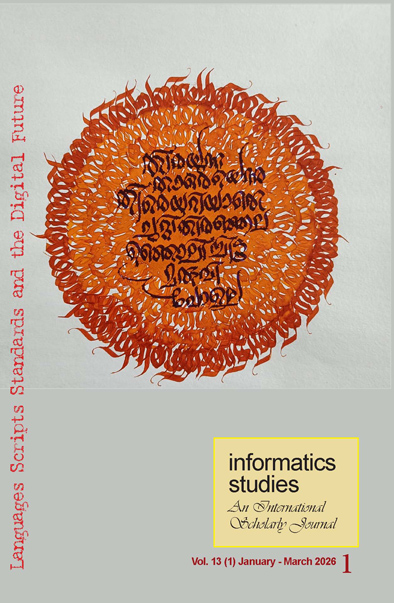
Dancing Malayalam Letters: Calligraphy and Digital Typography in Narayana Bhattathiri’s Work
Keywords:
Calligraphy, Unicode, Malaylam, Art, LanguageAbstract
This article explores the pioneering role of Narayana Bhattathiri in shaping the modern visual culture of Malayalam script through calligraphy, typography, and digital font design. While Malayalam literature had long celebrated the expressive power of words, the artistic possibilities of the script itself remained largely unexplored. Beginning in the early 1980s with his work in the weekly Kalakaumudi, Bhattathiri transformed Malayalam lettering into a vibrant visual art, designing titles for major literary works and redefining the aesthetics of printed text. Over four decades, his experiments established Malayalam calligraphy as an independent artistic discipline and introduced the language to the global calligraphy community. His collaborations with the Rachana Institute of Typography led to the development of Unicode Malayalam fonts that integrate traditional letterforms with contemporary digital standards. Through exhibitions, workshops, and international participation, Bhattathiri has also worked tirelessly to popularize calligraphy and advocate its inclusion in art education in Kerala.
References
Athir M (2022). Calligrapher Artist Bhattathiri opens 'Ka Cha Ta Tha Pa', a gallery for Malayalam calligraphy Hindu. August 11, 2022
Banarus Hindu University, Varanasi (2019). Kalakshar. International Seminar and Workshop. Design Innovation through socio cultural Diversity: From Art and Technology. https://www.facebook.com/kalaksharvaransi/. Accessed on 30.12.2026
Banarus Hindu University, Varanasi (2023). The Sacred and Typography. Typoday 25, https:// www.typoday.in/Narayana-Bhattathiri22.html . Accessed on 30.12.2026
Fathima Abdul Kader (2024). The Enduring Legacy of Narayana Bhattathiri: The Father of Malayalam Calligraphy. Homegrown. 07 May 2024, 4:51 pm
Jisha Surya (2017) Turning Malayalam calligraphy into a fine art. Times of India. December 18, 2017.
Kachadathapa (2025). Kachadathapa foundation Home page. https://www.kachatathapa.com/ . Accessed on 30.12.2026
Mathrubhumi (2021). കൈപ്പടക്കലയിൽ മലയാളത്തിന്റെ കൈത്തിരി (Kaippadakkalyil Malayalathinte kaithri) A feature on Artist Bhattathiri's Caligraphy . In Art Mathrubhumi.com. 15, November,2021. https://www.youtube.com/watch?v=q1LHTmLdJMM. Accessed on 30.12.2026
Narayana Bhattathir (2025). Mastering the Art of Malayalam Calligraphy. Tedx Talks. https://www.youtube.com/ watch?v=gMR6e4sS0Xg . Accessed on 30.12.2026
Prescia Gladwin (2024). Meeting Narayana Bhattathiri, the man behind the only gallery for calligraphy in India. The New indian Expresss. 16 Bebruary , 2024.
San Francisco Center for the Book (2029). Calligraphies in Conversation: An Exhibition of Multicultural Calligraphy. https://www.calligraphies.org/2019-exhibition . Accessed on 30.12.2026
Shyam A, Nirupama Singh (2026). Narayana Bhattathiri: New Experiment and Styles in Contemporary Malayalam Calligraphy. International Journal For Multidisciplinary Research. Volume 8 Issue 2. March-April 2026
Typoday (2025). Dancing Malayalam Letters: Typoday 25, IDC School of Design, IIT Bombay .2025. https://www.typoday.in/narayana.html . Accessed on 30.12.2026
Typography Society of India (2021). Calligraphy Demonstration by Narayana Bhattathiri.14, August, 2021 https://www.youtube.com/watch?v=KtR29wK3DEM. Accessed on 30.12.2026
Vinu Abraham (2026). അക്ഷരകലയുടെ സാഫല്യമായി ഭട്ടതിരി. (Aksharakalayude Saphalyamayi Bhttathri) - Vijnana Kairali.
Downloads
Published
Issue
Section
License
Submission of a manuscript to IS indicates that the work is original, has not been previously published (except as an abstract, lecture, or thesis), and is not under consideration by another journal. By submitting, authors affirm that their manuscript meets the journal’s ethical and editorial standards and that they agree to the terms of copyright and licensing upon acceptance.
Once accepted for publication, authors grant IS the first publication rights to the work. However, authors retain full copyright of their content and remain the legal owners of their intellectual property.
IS provides open access to all published articles six months after the release of the respective volume. Once the embargo period concludes, articles are made freely available under the Creative Commons Attribution (CC BY) License (https://creativecommons.org/licenses/by/4.0/). This license allows users to share, adapt, and reuse the work in any medium or format provided that appropriate credit is given to the original authors and the initial publication in this journal.
The journal's delayed open access model supports global knowledge dissemination, ensuring that research is accessible without financial or legal barriers. Authors are also encouraged to archive their published articles in institutional repositories, personal websites, or other platforms, with full citation of the journal version. Pre-print versions posted online should include a citation and link to the final published version in IS as soon as the issue is available; post-print versions (including the final publisher's PDF) should include a citation and link to the journal's website.
All materials published in the IS website are distributed under a Creative Commons Attribution license, unless otherwise noted.