Reclaiming Knowledge as a Commons: Historical Ethics and Contemporary Open Science
Keywords:
Open Knowledge, Open Science, Open Access, Knowledge Commons, Civilization, Renaissance, Sankara, Chattampi SwamikalAbstract
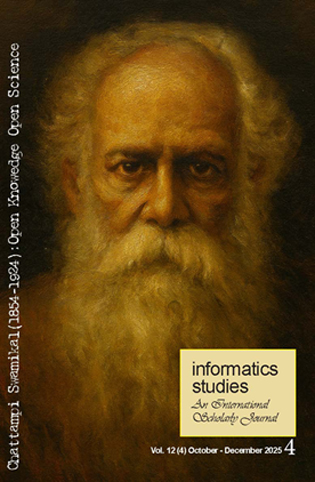
Introduces the papers in the volume discussing Open Knowledge and Open Science through historical, ethical, and civilizational perspectives. Moving beyond access-centric models, the studies foregrounds ethical responsibility, inclusivity, epistemic justice, and the social purpose of knowledge. The papers bring Western philosophical debates on knowledge commons into dialogue with Eastern knowledge traditions, demonstrating that contemporary principles of openness have deep historical antecedents. Central attention is given to figures of the Kerala Renaissance - Sankara, Chattampi Swamikal, Narayana Guru, and others whose efforts to dismantle epistemic monopolies, democratise sacred learning, and institutionalise inclusive education anticipate modern Open Science ideals. The papers also addresses contemporary challenges of linguistic and technological exclusion in digital repositories. Collectively, the articles argue that openness is a historically grounded ethical practice requiring a balance between access, responsibility, and cultural sensitivity, offering a civilizational framework for sustainable and equitable knowledge commons.
References
Berlin Declaration on Open Access to Knowledge in the Sciences and Humanities. (2003). Berlin: Max Plank Society. Retrieved February 01, 2007 from http://oa.mpg.de/openaccess-berlin/berlin_declaration.pdf
Sharp, P A, Bonvillian, W B, Desimone, R, et al (2023). Access to science and scholarship: Key questions about the future of research publishing (Report v1.5). Massachusetts Institute of Technology. Retrieved from https://hdl.handle.net/1721.1/152414
Chattampi Swamikal (2023). Vedadikara Niroopanam (Right to Learn Vedas: A Critique). (Composed and placed for discussion during 1890-93 period its first published in book form in 1918). Edited with a study by R. Raman Nair. Trivandrum, Chattampi Swami Archive.
Downloads
Published
Issue
Section
License
Submission of a manuscript to IS indicates that the work is original, has not been previously published (except as an abstract, lecture, or thesis), and is not under consideration by another journal. By submitting, authors affirm that their manuscript meets the journal’s ethical and editorial standards and that they agree to the terms of copyright and licensing upon acceptance.
Once accepted for publication, authors grant IS the first publication rights to the work. However, authors retain full copyright of their content and remain the legal owners of their intellectual property.
IS provides open access to all published articles six months after the release of the respective volume. Once the embargo period concludes, articles are made freely available under the Creative Commons Attribution (CC BY) License (https://creativecommons.org/licenses/by/4.0/). This license allows users to share, adapt, and reuse the work in any medium or format provided that appropriate credit is given to the original authors and the initial publication in this journal.
The journal's delayed open access model supports global knowledge dissemination, ensuring that research is accessible without financial or legal barriers. Authors are also encouraged to archive their published articles in institutional repositories, personal websites, or other platforms, with full citation of the journal version. Pre-print versions posted online should include a citation and link to the final published version in IS as soon as the issue is available; post-print versions (including the final publisher's PDF) should include a citation and link to the journal's website.
All materials published in the IS website are distributed under a Creative Commons Attribution license, unless otherwise noted.