Knowledge as a Commons: Philosophical Roots of Openness in East and West
Keywords:
Open Science, Open Knowledge, Open Access, Knowledge, Western Thought, Eastern Thought, Philosophy, Marx, Vedadikara Nirupanam, Communist ManifestoAbstract
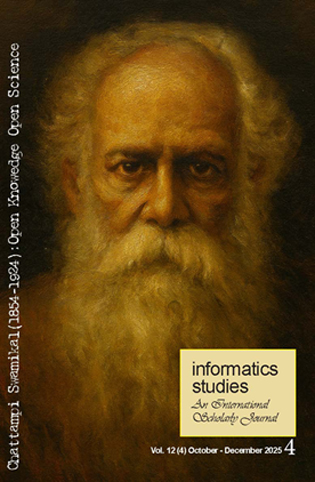
Western intellectual traditions have long recognized knowledge as a decisive force shaping economic productivity, social organization, and political authority. From the Enlightenment onward, the gradual displacement of theological authority by scientific rationality raised critical questions not only about the value of knowledge, but also about its accessibility, circulation, and social purpose. Although early thinkers did not employ contemporary terms such as Open Science or knowledge commons, many articulated principles emphasizing dissemination, public reasoning, and shared intellectual resources as essential conditions for social progress. This paper offers a bird’s-eye view of the concept of knowledge as power and the ethical imperative of its wide dissemination, as articulated across Eastern and Western intellectual traditions. It traces convergent ideas from Western thinkers such as Rousseau and Marx, to Eastern philosophical lineages represented by Sankara and Chattampi Swamikal, and extends the discussion to modern theorists including Joseph Schumpeter and Alvin Toffler. By situating contemporary debates on open knowledge within these broader philosophical trajectories, the paper highlights a shared civilizational concern with knowledge as a collective resource vital for social transformation and human emancipation.
References
Adam Smith (1776). An Inquiry into the Nature and Causes of the Wealth of Nations. London, W. Strahan and T. Cadell.
Al-Farabi (c. 940), On the Perfect State. Oxford, Oxford University Press.
Ambedkar, B.R. (1936). Annihilation of Caste. Bombay, Self-published.
Ayyankali (1910). Collected Speeches and Writings. Thiruvananthapuram, Government of Kerala.
Benkler, Yochai (2006). The Wealth of Networks: How Social Production Transforms Markets and Freedom. New Haven, Yale University Press.
Buddha (c. 5th century BCE). The Dhammapada. Various translations; New Delhi, Penguin Classics.
Chattampi Swami (2023. Vedadikara Niroopanam (Right to Learn Vedas: A Critique). (Composed and placed for discussion during 1890-93 and first printed in 1918). Edited with Study by R. Raman Nair. Trivandrum, Chattampi Swami Archive.
Comte, Auguste (1842). The Course of Positive Philosophy. Paris, Bachelier.
Confucius (c. 5th century BCE). The Analects. Beijing, Foreign Languages Press.
Foucault, Michel (1969), The Archaeology of Knowledge. Paris, Gallimard.
Francis, Pope (2020). Fratelli Tutti: Encyclical Letter on Fraternity and Social Friendship. Vatican City: Libreria Editrice Vaticana
Gandhi, Mahatma (1909). Hind Swaraj. Ahmedabad, Navajivan Publishing House.
Habermas, Jürgen (1962). The Structural Transformation of the Public Sphere. Frankfurt am Main, Suhrkamp.
Ibn Rushd (Averroes) (1180). The Incoherence of the Incoherence. London, Luzac & Co.
Ibn Sina (Avicenna) (1025). The Canon of Medicine. Cairo, Al-Matba'a al-Amiriyya.
Kant, Immanuel (1784), An Answer to the Question: What Is Enlightenment?. Berlinische Monatsschrift, December 1784.
Kelty, Christopher (2008). Two Bits: The Cultural Significance of Free Software. Durham, Duke University Press.
Laozi (c. 4th century BCE). Tao Te Ching. Beijing, Zhonghua Book Company.
Marx, Karl (1867), Capital: A Critique of Political Economy, Vol. I. Hamburg, Otto Meissner Verlag.
Marx, Karl and Engels, Friedrich (1848). The Communist Manifesto. London, Workers' Educational Association.
Mencius (c. 3rd century BCE). The Works of Mencius. Beijing, China Publishing Group.
Mill, John Stuart (1859). On Liberty. London, John W. Parker and Son.
Narayana Guru, Sree (1900). Atmopadesa Satakam. Aluva, Sarada Press.
Paine, Thomas (1791). Rights of Man. London, J.S. Jordan.
Ricardo, David (1817). On the Principles of Political Economy and Taxation. London, John Murray.
Rig Veda (c. 1500-1200 BCE). Selected Hymns. New Delhi, Motilal Banarsidas.
Rousseau, Jean-Jacques (1762). The Social Contract. Amsterdam, Marc-Michel Rey.
Saint-Simon, Henri de (1825). Selected Writings on Science, Industry and Social Organisation. Paris, Bossange.
Saliba, George (2007). Islamic Science and the Making of the European Renaissance. Cambridge, MIT Press.
Sankara (8th century CE). Commentaries on the Upanishads, Bhagavad Gita, and Brahma Sutra. Varanasi, Chowkhamba Sanskrit Series.
Sankara (8th century CE). Vivekachudamani: The Crest-Jewel of Discrimination. Calcutta, Advaitha Ashram, 1920.
Schumpeter, Joseph A. (1942). Capitalism, Socialism and Democracy. New York, Harper & Brothers.
Smith, Adam (1759). The Theory of Moral Sentiments. London, A. Millar.
Suber, Peter (2012), Open Access. Cambridge, MIT Press.
Tagore, Rabindranath (1931). The Religion of Man. London, George Allen & Unwin.
Toffler, Alvin (1980). The Third Wave. New York, William Morrow.
Toffler, Alvin (1990). Powershift: Knowledge, Wealth, and Violence at the Edge of the 21st Century. New York, Bantam Books.
UNESCO (2021). Recommendation on Open Science. Paris, UNESCO Publishing.
Vivekananda, Swami (1907). The Complete Works of Swami Vivekananda. Calcutta, Advaita Ashram.
Downloads
Published
Issue
Section
License
Submission of a manuscript to IS indicates that the work is original, has not been previously published (except as an abstract, lecture, or thesis), and is not under consideration by another journal. By submitting, authors affirm that their manuscript meets the journal’s ethical and editorial standards and that they agree to the terms of copyright and licensing upon acceptance.
Once accepted for publication, authors grant IS the first publication rights to the work. However, authors retain full copyright of their content and remain the legal owners of their intellectual property.
IS provides open access to all published articles six months after the release of the respective volume. Once the embargo period concludes, articles are made freely available under the Creative Commons Attribution (CC BY) License (https://creativecommons.org/licenses/by/4.0/). This license allows users to share, adapt, and reuse the work in any medium or format provided that appropriate credit is given to the original authors and the initial publication in this journal.
The journal's delayed open access model supports global knowledge dissemination, ensuring that research is accessible without financial or legal barriers. Authors are also encouraged to archive their published articles in institutional repositories, personal websites, or other platforms, with full citation of the journal version. Pre-print versions posted online should include a citation and link to the final published version in IS as soon as the issue is available; post-print versions (including the final publisher's PDF) should include a citation and link to the journal's website.
All materials published in the IS website are distributed under a Creative Commons Attribution license, unless otherwise noted.