Harvesting Knowledge, Preserving Life: Informatics in Sustainable Agriculture
Keywords:
Agricultural Informatics, Biosphere Conservation, Smart FarmsAbstract
Agricultural Informatics offers innovative solutions by integrating advanced technologies such as Artificial Intelligence (AI), satellite imagery, IoT, remote sensing, and blockchain to meet the rising demand for food resulting from population explosion. This evolving field transforms data into valuable insights that enable smarter, more sustainable farming practices. It supports initiatives like precision agriculture, climate-adaptive crops, intelligent pest management, and transparent supply chains, all aimed at enhancing productivity while protecting biodiversity. The papers in this volume showcase how leveraging informatics can address future food challenges, promoting both global food security and a thriving natural environment for future generations.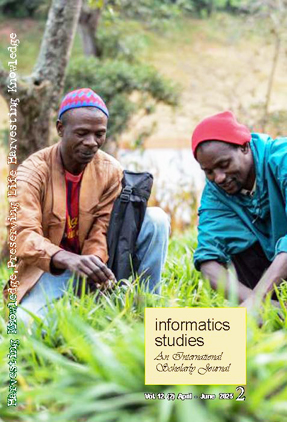
Downloads
Published
Issue
Section
License
Submission of a manuscript to IS indicates that the work is original, has not been previously published (except as an abstract, lecture, or thesis), and is not under consideration by another journal. By submitting, authors affirm that their manuscript meets the journal’s ethical and editorial standards and that they agree to the terms of copyright and licensing upon acceptance.
Once accepted for publication, authors grant IS the first publication rights to the work. However, authors retain full copyright of their content and remain the legal owners of their intellectual property.
IS provides open access to all published articles six months after the release of the respective volume. Once the embargo period concludes, articles are made freely available under the Creative Commons Attribution (CC BY) License (https://creativecommons.org/licenses/by/4.0/). This license allows users to share, adapt, and reuse the work in any medium or format provided that appropriate credit is given to the original authors and the initial publication in this journal.
The journal's delayed open access model supports global knowledge dissemination, ensuring that research is accessible without financial or legal barriers. Authors are also encouraged to archive their published articles in institutional repositories, personal websites, or other platforms, with full citation of the journal version. Pre-print versions posted online should include a citation and link to the final published version in IS as soon as the issue is available; post-print versions (including the final publisher's PDF) should include a citation and link to the journal's website.
All materials published in the IS website are distributed under a Creative Commons Attribution license, unless otherwise noted.