Historical Dimensions of Knowledge Access and Dissemination in India
Keywords:
Knowledge Management, Open Knowledge, India, History, Spirituality, printing, Education, SanskritAbstract
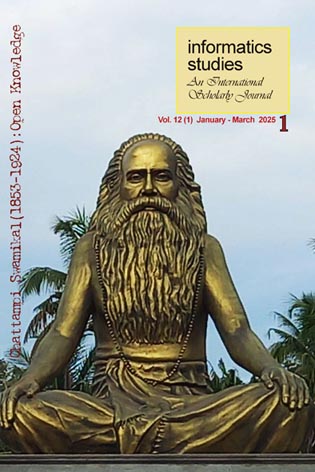
The paper provides an overview of how knowledge was transmitted and accessed in Indian society from ancient times. It explores the methods of knowledge transmission in traditional society, where personal interaction played a central role, before the advent of modern communication and the widespread availability of books. The study delves into how traditional culture was designed to ensure the passing down of knowledge, maintaining continuity in education. It also discusses traditional methods, subject-specific and audience-specific restrictions, as well as efforts to democratise knowledge. The paper focuses on Kerala's geographical context, knowledge transmission in philosophy and religion, and the contributions of intellectual figures like Chattampi Swamikal in this area. (The paper is adapted from the various writings of Ananda Wood)
References
Bhaskara Pilla, K (1960) Chattampi Swamikal. Kottayam, SPCS.
Karunakara Menon, K P (1967). Chattampi Swamikal. The Great Scholar-Saint of Kerala. Trivandrum. PGNP.
Kramrisch, Stella, J. H. Cousins, and R. Vasudev Poduval (1970). The Arts and Crafts of Kerala. Cochin, Paico Publishing House, A general and historical account of traditional crafts and performing arts in Kerala.
Krishna Chaitanya (1971). A History of Malayalam Literature, Orient Long-mans, Delhi. Includes a discussion of the historical and cultural background.
Krishna Chaitanya (1972). Kerala. New Delhi, National Book Trust. An overall account of Kerala and her culture, by a noted scholar.
Kunjunni Raja, K (1958). Contributions of Kerala to Sanskrit Literature, University of Madras, Madras. An account of Sanskrit learning and writing in Kerala, in particular the introduction describes the social organization of traditional learning in the feudal kingdoms of Kerala.
Raman Maharshi (2002). Raman Maharsh's Gospel Being Answers of Bhagvan Sree Raman maharshi to Questions put to Him by Devotees (Book 1, chapter 7), Sri Ramanasramam, Tiruvannamalai, Tamil Nadu, India
Sprigge, T L S, (1995). This characterization of Advaita as 'one in the many' comes from a remark by Professor T.L.S. Sprigge, who described Shr: Shankara's position in this way.
Sprigge, T. L. S. 2006. The God of Metaphysics. Oxford: Clarendon Press.
Sreedhara Menon, A (1970) A Survey of Kerala History. Kottayam, National Book Stall.
Wood, Ananda (1985). Knowledge before printing and after -The Indian tradition in changing Kerala, Oxford University Press, Delhi, 1985. The account here is taken specifically from Kerala state, as documented in this book.
Downloads
Published
Issue
Section
License
Submission of a manuscript to IS indicates that the work is original, has not been previously published (except as an abstract, lecture, or thesis), and is not under consideration by another journal. By submitting, authors affirm that their manuscript meets the journal’s ethical and editorial standards and that they agree to the terms of copyright and licensing upon acceptance.
Once accepted for publication, authors grant IS the first publication rights to the work. However, authors retain full copyright of their content and remain the legal owners of their intellectual property.
IS provides open access to all published articles six months after the release of the respective volume. Once the embargo period concludes, articles are made freely available under the Creative Commons Attribution (CC BY) License (https://creativecommons.org/licenses/by/4.0/). This license allows users to share, adapt, and reuse the work in any medium or format provided that appropriate credit is given to the original authors and the initial publication in this journal.
The journal's delayed open access model supports global knowledge dissemination, ensuring that research is accessible without financial or legal barriers. Authors are also encouraged to archive their published articles in institutional repositories, personal websites, or other platforms, with full citation of the journal version. Pre-print versions posted online should include a citation and link to the final published version in IS as soon as the issue is available; post-print versions (including the final publisher's PDF) should include a citation and link to the journal's website.
All materials published in the IS website are distributed under a Creative Commons Attribution license, unless otherwise noted.