Ecocentrism and Open Knowledge: A Unified Vision for Food, Health, and Environment from Traditional Wisdom
Keywords:
Ecocentrism, Open data, Sustainable Development Goals, Food as medicine, Healthcare, Biodiversity, Environmental philosophy, Traditional medicineAbstract
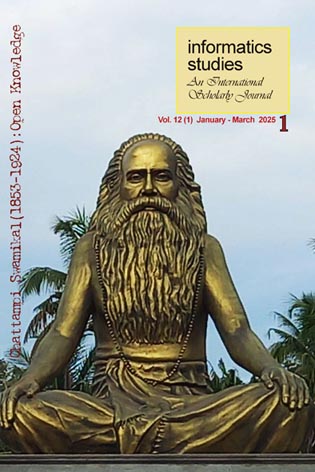
The food-first strategy, i.e., seeking nutritional solutions for preventing and managing diseases rather than relying on supplements, has recently gained momentum among the general public and policymakers, owing to increased awareness. Traditional medicine practitioners across the globe approach food as having therapeutic potential and dietary routine as a way of preventive healthcare. Conventional systems like Ayurveda in India included herbs, spices, and plant-derived/animal-derived components in specific preparations to be used to prevent/treat ailments. As these preparations are very particular about the source of raw materials, the preservation of the flora and fauna, and in broader terms, the biodiversity, is of paramount significance. Ancient knowledge in India emphasizes this aspect, and in Chattampi Swamikal’s teaching, ecocentrism is represented with an open knowledge approach. In our opinion, an eco-centric approach with open access to knowledge seems crucial for achieving sustainable development, especially concerning food, health, and the environment.
References
Al Mamun, A., Prasetya, T. A. E., Dewi, I. R., & Ahmad, M. (2023). Microplastics in human food chains: Food becoming a threat to health safety. Science of the Total Environment, 858, 159834.
Boeing, H., Bechthold, A., Bub, A., Ellinger, S., Haller, D., Kroke, A., ... & Watzl, B. (2012). Critical review: vegetables and fruit in the prevention of chronic diseases. European journal of nutrition, 51, 637-663.
Chattampi Swamikal (2013). Apoorva Chikitsa Vidhikal. Collected and edited with a study by Suresh Madhav. Trivandrum, State Institute of languages.
Chattampi Swamikal (2019). Jeevakarunya Nirupanam. First CSIS Edition, Trivandrum, Centre for South Indian Studies. Reprint
Chattampi Swamikal (2024). A Brief Exposition of the Principles of the Body. Translation of the Sareeratatva Sangraham by S Jagathsimhan Nair. In: Advaita School of Thought. Vallikunnam, Vidyadhiraja International.
Chattampi Swamikal (2024a). Compassion: A Critique. Translation of Jeevakarunaya Nirupanam by S Jagathsimhan Nair. Vallikunnam, Vidyadhiraja International, 2024.
Cverenkárová, K., Valachovicová, M., Mackulak, T., Elisa, L., & Bírošová, L. (2021). Microplastics in the Food Chain. Life, 11(12), 1349. https://doi.org/10.3390/life11121349
Darnthamrongkul, W. and Mozingo, L.A., (2020). Challenging anthropocentric storm water management: Advancing legislation for environmental sustainability in the United States. Water Security, 10, p.100064.
Friebe, M. (2022). From SICKCARE to HEALTHCARE to HEALTH. In: Friebe, M. (eds) Novel Innovation Design for the Future of Health. Springer, Cham. https://doi.org/10.1007/978-3-031-08191-0_3
González N, Marquès M, Nadal M, Domingo JL. (2020) Meat consumption: Which are the current global risks? A review of recent (2010-2020) evidences. Food Res Int. 137:109341. doi: 10.1016/j.foodres.2020.109341. Epub 2020 May 29. Erratum in: Food Res Int. 2020 Nov;137:109620. doi: 10.1016/j.foodres.2020.109620. PMID: 33233049; PMCID: PMC7256495.
Guest, N. S., Raj, S., Landry, M. J., Mangels, A. R., Pawlak, R., Senkus, K. E., ... & Rozga, M. (2024). Vegetarian and Vegan Dietary Patterns to Treat Adult Type 2 Diabetes: A Systematic Review and Meta-Analysis of Randomized Controlled Trials. Advances in Nutrition, 100294.
Isobe, A., Azuma, T., Cordova, M.R. et al. (2021). A multilevel dataset of micro plastic abundance in the world's upper ocean and the Laurentian Great Lakes. Micropl.&Nanopl. 1, 16 https://doi.org/10.1186/s43591-021-00013-z
Khanna, M. (2014). Ecological Insights in the Atharva Veda and Their Relevance Today. India International Centre.
Khanal, A. et al. (2021). Culinary herbs and spices in Nepal: A review of their traditional uses, chemical constituents, and pharmacological activities. Ethnobotany Res. Appl. 21
Lebreton, L., van der Zwet, J., Damsteeg, JW. et al. (2017). River plastic emissions to the world's oceans. Nat Commun 8, 15611 https://doi.org/10.1038/ncomms15611
Loiseau, E., Saikku, L., Antikainen, R., Droste, N., Hansjürgens, B., Pitkänen, K., Leskinen, P., Kuikman, P. and Thomsen, M. (2016). Green economy and related concepts: An overview. Journal of cleaner production, 139, pp.361-371.10.1016/j.jclepro.2016.08.024.
Mozaffarian D, Blanck HM, Garfield KM, Wassung A, Petersen R. A (2022). Food is Medicine approach to achieve nutrition security and improve health. Nat Med. 28(11):2238-2240. doi: 10.1038/s41591-022-02027-3. PMID: 36202998; PMCID: PMC10851911.
NV, R., & Mishra, A. (2019). Traditional methods of food habits and dietary preparations in Ayurveda—the Indian system of medicine. Journal of Ethnic foods, 6(1), 1-9.
Redvers, N. & Blondin, B. (2020). Traditional indigenous medicine in North America: A scoping review. PLoS ONE 15, e0237531
Salis, S., Virmani, A., Priyambada, L., Mohan, M., Hansda, K., & Beaufort, C. D. (2021). ‘Old is gold’: How traditional Indian dietary practices can support pediatric diabetes management. Nutrients, 13(12), 4427
Satija, A., & Hu, F. B. (2018). Plant-based diets and cardiovascular health. Trends in cardiovascular medicine, 28(7), 437-441
Scarborough, P., Clark, M., Cobiac, L. et al. (2023). Vegans, vegetarians, fish-eaters and meat-eaters in the UK show discrepant environmental impacts. Nat Food 4, 565-574. https://doi.org/10.1038/s43016-023-00795-w
Shridhar, K., Dhillon, P. K., Bowen, L., Kinra, S., Bharathi, A. V., Prabhakaran, D., ... & Indian Migration Study Group. (2014). The association between a vegetarian diet and cardiovascular disease (CVD) risk factors in India: the Indian Migration Study. PloS one, 9(10), e110586.
Söderholm, P. (2020). The green economy transition: the challenges of technological change for sustainability. Sustain Earth 3, 6. https://doi.org/10.1186/s42055-020-00029-y
Stahel, W. (2016). The circular economy. Nature 531, 435-438. https://doi.org/10.1038/531435a
Stamolis, V. L. & Bagley, C. B. (1938) Chief Seattle's Address. Washington. [Manuscript/ Mixed Material] Retrieved from the Library of Congress, https:// www.loc.gov/ item/ wpalh002770/.
ten Have, H, Patrão Neves, M. (2021). Ecocentrism (See Anthropocentrism; Biocentrism; Environmental Ethics; Zoocentrism). In: Dictionary of Global Bioethics. Springer, Cham. https://doi.org/10.1007/978-3-030-54161-3_220
Thompson, S. C. G., & Barton, M. A. (1994). Ecocentric and anthropocentric attitudes toward the environment. Journal of environmental Psychology, 14(2), 149-157.
Truswell, E., Smith, F. and Gerry, W., (2015). Supporting sustainable development with Open Data. https:// theodi.cdn.ngo/ media/documents/255317927- Supporting- sustainable- development- with- open- data.pdf
Wang, T., Kroeger, C. M., Cassidy, S., Mitra, S., Ribeiro, R. V., Jose, S., ... & Fontana, L. (2023). Vegetarian dietary patterns and cardiometabolic risk in people with or at high risk of cardiovascular disease: a systematic review and meta-analysis. JAMA Network Open, 6(7), e2325658-e2325658.
Wang T, Masedunskas A, Willett WC, Fontana L. (2023a). Vegetarian and vegan diets: benefits and drawbacks. Eur Heart J. 44(36):3423-3439. doi: 10.1093/eurheartj/ehad436. PMID: 37450568; PMCID: PMC10516628.
Whitney, William Dwight and Lanman, Charles Rockwell. Tr and Com (1906). Atharva-Veda samhita; translated with a critical and exegetical commentary. Book XII, Hymn 1. 3 and 11. (Dvadasha Khanda, Anuvaka 1 Suktha 1 (Prithvisuktha): 12.1.3 and 12.1.11) Harward Oriental Series. Cambridge, Massachusets, Harvard University.
Yu, Z., Ke, L., Lu, T. et al. (2024). Implementing a food-first strategy can transform preventive healthcare. npj Sci Food 8, 57. https://doi.org/10.1038/s41538-024-00297-4
Further Reading
Bendich, A., & Deckelbaum, R. J. (2005). Preventive nutrition. Humana Press.
Chattambi Swamikal (1953). Ahimsa. Satabdasmaraka Grantha, Kollam, Sree Rama Vilasam Press.
Colglazier, W. (2015). Sustainable development agenda: 2030. Science, 349(6252), 1048-1050.
Nirmalananda Giri, Swami. (2005). Non-injury: The ultimate Dharma. Kerala Calling, September 2005.
Policy note ICT01, Open data for sustainable development, Aug 2015, World Bank group. https://thedocs.worldbank.org/en/doc/741081441230716917-0190022015/
Vannucci, Marta. Ecological Readings in the Vedas. New Delhi, DK Print World, 1994.
Vannucci, Marta. Human Ecology in the Vedas. New Delhi, DK Print World, 1999.
Note: The views expressed in the article are solely of the authors and not of their respective organizations
Downloads
Additional Files
Published
Issue
Section
License
Submission of a manuscript to IS indicates that the work is original, has not been previously published (except as an abstract, lecture, or thesis), and is not under consideration by another journal. By submitting, authors affirm that their manuscript meets the journal’s ethical and editorial standards and that they agree to the terms of copyright and licensing upon acceptance.
Once accepted for publication, authors grant IS the first publication rights to the work. However, authors retain full copyright of their content and remain the legal owners of their intellectual property.
IS provides open access to all published articles six months after the release of the respective volume. Once the embargo period concludes, articles are made freely available under the Creative Commons Attribution (CC BY) License (https://creativecommons.org/licenses/by/4.0/). This license allows users to share, adapt, and reuse the work in any medium or format provided that appropriate credit is given to the original authors and the initial publication in this journal.
The journal's delayed open access model supports global knowledge dissemination, ensuring that research is accessible without financial or legal barriers. Authors are also encouraged to archive their published articles in institutional repositories, personal websites, or other platforms, with full citation of the journal version. Pre-print versions posted online should include a citation and link to the final published version in IS as soon as the issue is available; post-print versions (including the final publisher's PDF) should include a citation and link to the journal's website.
All materials published in the IS website are distributed under a Creative Commons Attribution license, unless otherwise noted.