The Open Knowledge Vision of Christumatha Saram
Keywords:
Open Knowledge, Open Access, Bible, Christianity, Teachings of Jesus, India, Malayalam, Chattampi Swami, Christumatha S?ram, Interreligious Studies, Social ReformAbstract
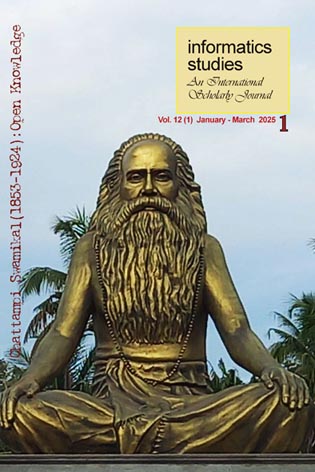
Chattampi Swami (Swamikal) a religious reformer from the late nineteenth century India seeks to capture the core elements of the Christian faith in his booklet Christumatha S?ram (CMS). His effort is commendable, as it demonstrates the openness and willingness of one from a different faith to take on this task. It serves as a valuable tool for evangelising those who may be misinformed or uninformed, and it was a timely contribution, particularly in an era when Christian literature was scarce in the region. SWAMIKAL subtly yet powerfully emphasizes the importance of understanding the Sacred Scriptures and the teachings of all religions, advocating for inter-religious dialogue, which was particularly relevant at the time. However, in his zeal to present the Gospel of Christ, Swamikal becomes overly influenced by Old Testament teachings, fails to consider some key aspects of Christian doctrine that define the Christian way of life. Despite this, his work is aimed at introducing the essence of Christianity to the Indian population at a time when the Bible was not accessible, especially in regional languages in India. By making the teachings of the Bible accessible in a culturally relatable format, CMS stands as a testament to Swamikal’s vision of spiritual inclusivity and his commitment to making knowledge open and accessible to all.
References
Agur, C M (1903). Church History of Travancore. Reprint 1998. Delhi, Asian Educational Society
Baskarapilla, K (1960). Chattampi Swamikal. Kottayam, National Book Stall, 1960.
Betty Mol Mathew (2021). Aadyapaapavimarshanam. In Unnikrishnan, Ed. Chattampi Swami Padanangal. Kottayam, DC.
Bible Society of India. The Holy Bible. English Standard Version Containing Old and New Testaments. Bangalore, BSI, ESV Text Edition, 2007.
Boyd, Robin (1975). An Introduction to Indian Christian Theology (Revised ed.). Madras: Christian Literature Society.
Chattampi Swamikal (1889) Christhumatha Saram (CSM). Chattampi Swami Archive Reprint. Trivandrum, CSA, 2020.
Col (1989). The Letter of Paul to the Colossians, 1:15. Holy Bible. New Revised Standard Version. Catholic Edition for India. Published by Thomas Nelson for Theological Publications in India, Bangalore, 1989.
Corinthians (1989). The Second Letter of Paul to the Corinthians, 13:13 . Holy Bible. New Revised Standard Ver.
Dominic. J Kattoor (2021). Yahovayude Daivalakshana Niirupanam. In Unnikrishnan, Ed. Chattampi Swami Padanangal. Kottayam, DC.
Gen (1989).The Book of Genesis 1:27. Holy Bible . The New Revised Standard Ver.
Gupatan Nair, S. Aadhyathmika Navothanathinte Silpikal. Kozhikode, Mathrubhumi Books, 2008.
Holy Bible. The New Revised Standard Version. Catholic Edition for India. Published by
John (1989). The Gospel of Jesus according to John, 1:3, 8:32, 10;10, 12:24, 12:29-31, 13:34, 14:5, 14:17, 15:11, 15;13. Holy Bible. New Revised Standard Ver.
Jones, Arun (2012). Christianity in South Asia. In Farhadian, Charles E. (ed.). Introducing World Christianity. Malden, MA: Blackwell Publishing.
Kumar J. J. (2021). Muktisadhana Nirupanam. In Chattampi Swami Padanangal. Kottayam, DC.
Lewis, James R. (2003). Legitimating New Religions. Rutgers University Press.
Luke (1989), The Gospel of Jesus according to Luke. 2;14, 6:36, 10:37. Holy Bible. New Revised Standard Ver.
Mark (1989). The Gospel of Jesus according to Mark, 1;15, 2:17, 2:27. Holy Bible. New Revised Standard Ver.
Mathew(1989). The Gospel of Jesus according to Matthew.5:44, 5;45, .5;20, 7:12. 14:22, 15:11, 25:34-36, 25;40. Holy Bible. New Revised Standard Ver.
Mingana, Alphonse (1926). The Early Spread of Christianity in India. Bulletin of the John Rylands Library. 10 (2): 435-514
Moraes, George M. (1964). A History of Christianity in India: From Early Times to St. Francis Xavier: A.D. 52-1542. Bombay: Manaktalas.
Neill, Stephen (1985). History of Christianity in India: 1707-1858. Cambridge: Cambridge University Press
Nelson, Thomas (1993). The Holy Bible. The New Revised Standard Version Catholic Edition. Bangalore, Theological Publications in India, 1993.
Oddie, Geoffrey A (1996). Christianity and social mobility in South India 1840-1920: A continuing debate". South Asia: Journal of South Asian Studies. 19 (1): 143-159.
Panikkar, K. M (1959). Asia and Western dominance. London: Allen & Unwin.
Paul Manalil (2021). Aathmajnaanatinte Aathmaprakaashanangal. In. Chattampi Swami Padanangal. Kottayam, DC.
Philippians (1989). The Second Letter of Paul to the Philippians, 4;4. Holy Bible. New Revised Standard Ver.
Raman Nair, R & Sulochana Devi, L (2010). Chattampi Swami: An Intellectual Biography. Trivandrum, Centre for South Indian Studies, 2010.
Robinson, Rowena (2003). Christians of India. Sage Publications.
Shaini. Thomas. (2021). Yahovayude Raksha Nirupanam. In Chattampi Swami Padanangal. Kottayam, DC.
Shiju. K. (2021). Christhu Matha Vyaapana Charitra Vimarshanam. In Chattampi Swami Padanangal. Kottayam, DC.
Shourie, Arun. (2006). Missionaries in India: Continuities, changes, and dilemmas. New Delhi: Rupa.
Sreekumar. S. (2021). Entukondu Christu Matha Chethanam? In Chattampi Swami Padanangal. Kottayam, DC.
Sreenathan. M. (2021). Malayalathile Aadya Gadhya Nrupana Mathrika. In Chattampi Swami Padanangal. Kottayam, DC.
Stot, John R W. (1958) Basics of Chritianity. Michigan, Eerdamans Publishing.
Suresh Madhav (2022) Christhu Matha Nirupanam: Sandharbavum Prameyavum. In Chattampi Swamikal). Christhu Matha Nirupanam. Trivandrum, CSIS.
Thomas Nelson for Theological Publications in India, Bangalore, 1989.
Unnikrishnan. A M. (2021). Chattampi Swami Padanangal (3 Vols) Kottayam, D C Books. 2021. In Unnikrishnan, Ed. Chattampi Swami Padanangal. Kottayam, DC.
Varghese. . (2021). Yeshuvinte Daivathva Vishakalanam. In. Chattampi Swami Padanangal. Kottayam, DC.
Downloads
Published
Issue
Section
License
Submission of a manuscript to IS indicates that the work is original, has not been previously published (except as an abstract, lecture, or thesis), and is not under consideration by another journal. By submitting, authors affirm that their manuscript meets the journal’s ethical and editorial standards and that they agree to the terms of copyright and licensing upon acceptance.
Once accepted for publication, authors grant IS the first publication rights to the work. However, authors retain full copyright of their content and remain the legal owners of their intellectual property.
IS provides open access to all published articles six months after the release of the respective volume. Once the embargo period concludes, articles are made freely available under the Creative Commons Attribution (CC BY) License (https://creativecommons.org/licenses/by/4.0/). This license allows users to share, adapt, and reuse the work in any medium or format provided that appropriate credit is given to the original authors and the initial publication in this journal.
The journal's delayed open access model supports global knowledge dissemination, ensuring that research is accessible without financial or legal barriers. Authors are also encouraged to archive their published articles in institutional repositories, personal websites, or other platforms, with full citation of the journal version. Pre-print versions posted online should include a citation and link to the final published version in IS as soon as the issue is available; post-print versions (including the final publisher's PDF) should include a citation and link to the journal's website.
All materials published in the IS website are distributed under a Creative Commons Attribution license, unless otherwise noted.