Open Knowledge in Medical Sciences in Ninteenth Century South India
Keywords:
Roga, ?rogya, body, Sam?dhi, vy?dhi, sth?la?ar?ra, s?k?ma?ar?ra, k?ra?a?ar?ra. Open Knowedge, Open Science, Open Access, Ayurveda, Siddha, Medial Sciences, Yoga, Health, Food, India, KeralaAbstract
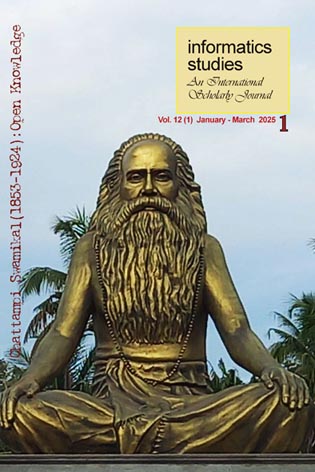
Chattampi Swamikal played a pivotal role in democratising medical knowledge during a time when it was restricted to a few select families or communities. His efforts laid the groundwork for a more inclusive healthcare culture in South India. A scholar in Vedanta, Yoga, and traditional systems of medicine, Swamikal approached the concepts of disease and health by starting with the body as the most tangible aspect of human existence and advancing to the mind and its modes. He explained the intricate and holistic nature of health and disease in a manner accessible to the common people. By breaking the monopoly on medical knowledge, Swamikal ensured that the ancient medical traditions of India became a shared heritage available for education, practice, and public benefit. His contributions remain significant today, as systems like Ayurveda and Siddha continue to thrive globally as essential frameworks for holistic health. This article explores the theoretical, philosophical, and practical dimensions of medical practice and access to knowledge as envisioned by Swamikal.
References
Bhaskarapilla.K. (1960). Chattampi Swamikal. Kottayam. Sahitya Pravarthaka Sahakarana Samgham.
Chattampi Swamikal (2013). Apurvachikitsavidhi. Ed. Suresh. Trivandrum, Kerala Basha Institute.
Chattampi Swamikal (2019). Jeevakarunya Nirupanam. Trivandrum, Chattampi Swami Archive. Reprinted with study by L. Sulochana Devi.
Iswara Pilla.R (1961). Vidyadhiraja Chattampi Swamikalute Jeevacharithram, Sri Mahabharatam Press, Annamanata.
Jayapradeep, M (2024). Liberating Access to Knowledge. Validating Access and Rights in Nineteenth Century India. Informatics Studies, 11 (2).
Karunakaran, C.O (1966). A Near Contemporary Speaks. Souvenir published on the occasion of the 80 birthday of Dr. Mrs. Poonen Lukose.
Lochan, Kanjiv, Ed. (2017) Astanga Hridaya of Vagbhata (Text with English Translation and Notes). Varanasi, Chaukhambha Publications.
Maheswaran Nair.K (1995). Chattampi Swamikal- Jeevithavum Krtikalum. Thiruvananthapuram, Dooma Books,
Narayanapilla, Aranmula M.K (2017). Sadgurusarvawsam. Translation and Commentary by Sulochanadevi.L. Thiruvvananthapuram, Centre For South Indian Studies,
Neelakanta Theerthapada (1906). Hatayoga Pradeepika. Vallikunnam, Arampil Govindhan Unnithan
Neelakanta Theerthapada (1910). Yogarahasyakaumudhi. In:Yogamritha Tharangini. Banaras, Sivaprasada
Raghavan Thirumulpad, K (2003). Ente Gurudarsanam. Chalakudy, Gayatri Asramam. Raghavan Thirumulpad, K (1998). Ashtangadarsanam. Thiruvananthapuram, Kerala Bhasha Institute.
Raghavan Thirumulpad, K (1995). Ayurvedaparichayam. Kochi, Nagarjuna Research Foundation.
Raghavan Thirumulpad, K (2002). Bhaishajyadarsanam. Thiruvananthapuram, Kerala Bhasha Institute.
Rajasekharan Nair, K (2015). A Pioneer Medicine - Dr. Mary Poonen Lukose (1886-1976). Samyukta - A Journal of Women’s Studies. 2 (2): 117-121.
Raman Nair.R. & Sulochana Devi, L (2010). Chattampi Swamikal- An Intellectual Biography. Thiruvananthapuram, Centre for South Indian Studies.
Santhakumari Amma, Kumbalath (1995). Memoirs. In Vidyadhiraja Chattampi Swamikal. Ed by Jagathi Velayudhan Nair.Trivandrum, Vidyadhiraja Viswa Kendram.
Srikantha Murthy, K R, Ed (1999). Astanga Samgraha of Vagbhata (Original text with Authentic English Translation, and Notes) Varanasi, Chaukhambha Publications
Swahanandha, Swami, Ed and Tr. (2012). Pancadasi of Sri Vidyaranya Swami. English Translation. Calcutta, Sree Rmakrishna Matt.
Wilson, Caroline (2011). “The social transformation of the medical profession in urban Kerala: Doctors, social mobility and the middle classes”. In: Donner, Henrike (ed.). Being Middle-class in India: A Way of Life. Abingdon, Oxon: Rutledge.
Downloads
Published
Issue
Section
License
Submission of a manuscript to IS indicates that the work is original, has not been previously published (except as an abstract, lecture, or thesis), and is not under consideration by another journal. By submitting, authors affirm that their manuscript meets the journal’s ethical and editorial standards and that they agree to the terms of copyright and licensing upon acceptance.
Once accepted for publication, authors grant IS the first publication rights to the work. However, authors retain full copyright of their content and remain the legal owners of their intellectual property.
IS provides open access to all published articles six months after the release of the respective volume. Once the embargo period concludes, articles are made freely available under the Creative Commons Attribution (CC BY) License (https://creativecommons.org/licenses/by/4.0/). This license allows users to share, adapt, and reuse the work in any medium or format provided that appropriate credit is given to the original authors and the initial publication in this journal.
The journal's delayed open access model supports global knowledge dissemination, ensuring that research is accessible without financial or legal barriers. Authors are also encouraged to archive their published articles in institutional repositories, personal websites, or other platforms, with full citation of the journal version. Pre-print versions posted online should include a citation and link to the final published version in IS as soon as the issue is available; post-print versions (including the final publisher's PDF) should include a citation and link to the journal's website.
All materials published in the IS website are distributed under a Creative Commons Attribution license, unless otherwise noted.