Chattampi Swamikal, Viewed Through Modern Discourses on Knowledge and Freedom.
Keywords:
Knowledge, Open Access, Literature, Prose for Intellectual Discourse, Vedas, Chattampi Swamikal, Richard Stallman, copy-left, copyright, free software movementAbstract
Chattampi Swamikal's Vedadikara Nirupanam, written in the late 19th century with modern research techniques, effectively argues that anyone can access, learn, teach, and interpret the Vedas. He critically examined the nature and content of the Vedas and even criticized revered saints like Adi Sankara for their indefensible views on the matter. Swamikal was the first major Indian saint to use prose for intellectual discourse, yet another step toward making knowledge more accessible to the masses. If he had chosen to write in Sanskrit poetry, which he was capable of, the knowledge would have remained inaccessible to most people. He understood that it was time to conduct intellectual discussions in a more everyday style and adopted this approach. This editorial note introduces the topic and gives an overview of the papers included in the issue that explore Chattampi Swamikal's wisdom from diverse perspectives, focusing on the freedom of knowledge, as supported by the modern open access movement.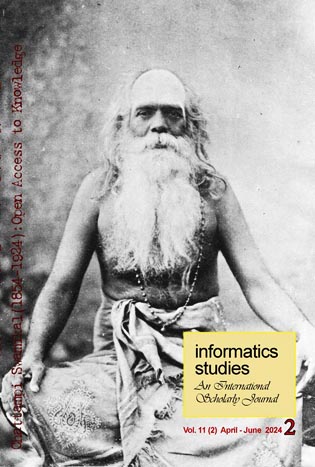
Downloads
Published
Issue
Section
License
Submission of a manuscript to IS indicates that the work is original, has not been previously published (except as an abstract, lecture, or thesis), and is not under consideration by another journal. By submitting, authors affirm that their manuscript meets the journal’s ethical and editorial standards and that they agree to the terms of copyright and licensing upon acceptance.
Once accepted for publication, authors grant IS the first publication rights to the work. However, authors retain full copyright of their content and remain the legal owners of their intellectual property.
IS provides open access to all published articles six months after the release of the respective volume. Once the embargo period concludes, articles are made freely available under the Creative Commons Attribution (CC BY) License (https://creativecommons.org/licenses/by/4.0/). This license allows users to share, adapt, and reuse the work in any medium or format provided that appropriate credit is given to the original authors and the initial publication in this journal.
The journal's delayed open access model supports global knowledge dissemination, ensuring that research is accessible without financial or legal barriers. Authors are also encouraged to archive their published articles in institutional repositories, personal websites, or other platforms, with full citation of the journal version. Pre-print versions posted online should include a citation and link to the final published version in IS as soon as the issue is available; post-print versions (including the final publisher's PDF) should include a citation and link to the journal's website.
All materials published in the IS website are distributed under a Creative Commons Attribution license, unless otherwise noted.