The Vedas: Repository of Knowledge: A Societal Endeavor Beyond Class Boundaries
Keywords:
Open Access, Vedas, Education, Right to Knowledge, Open Knowledge, Ancient Scientific KnowledgeAbstract
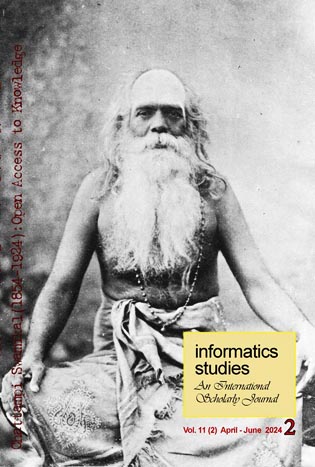
This paper aims to discuss explore the content of the Vedas, a topic addressed in Chattampi Swamikal's influential work 'Vedadikara Nirupanam' (The Right to Learn Vedas: A Critique), written in the late nineteenth century. Swamikal's seminal treatise challenged the prevailing laws that restricted the majority of the population from learning and teaching the Vedas. However, the term Veda used 'Vedadikara Nirupanam', is understood ony within a narrow religious context. Despite this limitation, Swamikal's work sparked significant societal transformations. Beyond advocating for religious rights, Swamikal emphasized the importance of access to all forms of knowledge for individual and societal development. This study prompts an examination into whether his focus was solely on religious education or if he intended broader implications. It discusses the specific interpretation of the Vedas that Swamikal intended. The paper can reveal that that Swamikal's ideas align closely with modern movements such as Open Access, Open Knowledge, and Open Science, which aim to dismantle barriers to information and foster a more inclusive and fair sharing of knowledge globally.
References
Avari, Burjor (2007). India: The Ancient Past, London: Routledge.
Bhattacharya, Ashim (2006), Hindu Dharma: Introduction to Scriptures and Theology, iUniverse.
Chattampi Swamikal (2019). Vedadhikara Nirupanam. Reprint with studies. Trivandrum, Centre for South Indian Studies.
Chattampi Swamikal (2024). Right to Learn Vedas: A Critique. Vallikunnam, Vidyadhiraja International
Doniger, Wendy (2010). The Hindus: An Alternative History, Oxford University Press
Flood, Gavin (1996). An Introduction to Hinduism, Cambridge University Press.
Griffiths, Paul J (1999). Religious Reading: The Place of Reading in the Practice of Religion, Oxford University Press
Kumar, Jay (2014). Ayurveda and Early Indian Medicine", in Johnston, Lucas F.; Bauman, Whitney (eds.), Science and Religion: One Planet, Many Possibilities, Routledge
Michaels, Axel (2004). Hinduism: Past and Present, Princeton University Press.
Santucci, J.A (1976). An Outline of Vedic Literature", Scholars Press for the American Academy of Religion
Downloads
Published
Issue
Section
License
Submission of a manuscript to IS indicates that the work is original, has not been previously published (except as an abstract, lecture, or thesis), and is not under consideration by another journal. By submitting, authors affirm that their manuscript meets the journal’s ethical and editorial standards and that they agree to the terms of copyright and licensing upon acceptance.
Once accepted for publication, authors grant IS the first publication rights to the work. However, authors retain full copyright of their content and remain the legal owners of their intellectual property.
IS provides open access to all published articles six months after the release of the respective volume. Once the embargo period concludes, articles are made freely available under the Creative Commons Attribution (CC BY) License (https://creativecommons.org/licenses/by/4.0/). This license allows users to share, adapt, and reuse the work in any medium or format provided that appropriate credit is given to the original authors and the initial publication in this journal.
The journal's delayed open access model supports global knowledge dissemination, ensuring that research is accessible without financial or legal barriers. Authors are also encouraged to archive their published articles in institutional repositories, personal websites, or other platforms, with full citation of the journal version. Pre-print versions posted online should include a citation and link to the final published version in IS as soon as the issue is available; post-print versions (including the final publisher's PDF) should include a citation and link to the journal's website.
All materials published in the IS website are distributed under a Creative Commons Attribution license, unless otherwise noted.