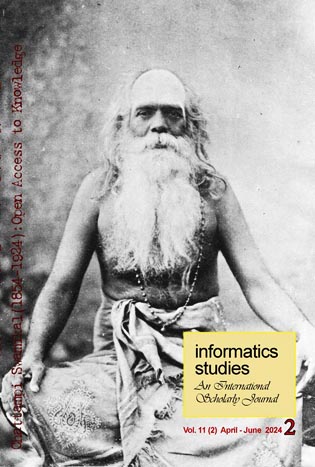
Chattampi Swami Studies: A Bibliometric Analysis of the Intellectual Spectrum of a Scholar Saint
Keywords:
Chattampi Swamikal, India, Kerala, History, Renaissance, Reformation, Religion, Hinduism, Right to Education, Access to KnowledgeAbstract
This study is based on the bibliographical data collected by Chattampi Swami Archive which covers all his essays, monographs, books, notes, unpublished manuscripts and letters as well as studies on his life and works and also that of his disciples and associates. Documents spanning from 1910 to 2024 (up to March, 31) and their contents pages are examined to account Chattampi Swamikal's influence and contributions. It uncovered 1252 documents, showcasing Swamikal's scholarly impact across different disciplines over a century. The studies by scholars from diverse backgrounds identified reveal insights beneficial to researchers interested in India's renaissance period; and they reflect Swamikal's significance Indian history. The analysis revealed that despite availability of a vast collection of materials documenting Swamikal's role as a catalyst for Kerala's renaissance and its subsequent reformation, formal acknowledgment in academic and governmental texts was lacking until recently. The study goes beyond the bibliographical level to content analysis in a limited sense to support researchers. The paper concludes that the documents identified and discussed can act as a valuable source for further research, contributing to a deeper understanding of India's historical renaissance and ongoing modernization processes.
References
Chattampi Swami Archive Trust (2023). Chattampi Swamikal: the Harbinger of Renaissance in India. (Mahaguruvarsham Publication. Trivandrum, Chattampi Swami Archive Trust, 2024).
Raman Nair, R. and Sulochana Devi, L. (2010). Chattampi Swami: An Intellectual Biography. (Translated into Malayalam as 'Chattampi Swamikal: Oru Dhaishanika Jeevacharithram', published in 2016) Thiruvananthapuram, Chattampi Swami Archive Trust, 2010.
Ranganathan, Shiyali Ramamritha (1963). Documentation and its Facets. Bombay, Asia Publishing House, Bombay.
Unnikrishnan, E. M. (2022). Chattampi Swami Padanangal. Three Volumes, 220 Essays, Kottayam, D C Books / P K Parameswaran Nayar Trust, 2021.
Gopala Pillai, Paravur, K. (1934). Life History of the Great Personality Chattampi Swami. Thrissur. Ramanujam Mudranaalayam (Publisher: P. K. Ammuni Menon), 1934.
Chattampi Swami (1918). Right to Study Vedas: A critique. Vallikunnam, Vidyadhiraja International, 2024.
Narayanan Pillai, Aranmula M. K. (1908). Sadguru Sarvasvam. Benaras, Arampil Govindan Unnithan. 1910
Narayanan Pillai, P. G. Upaharamalika. Mahasamadhi Memorial of Paramabhattara Sri Chattampi Swami. Kollam. Shrirama Vilasam Press, 1950.
Parameswaran Nair, P. K. Ed. Centennial Memorial Book of Sri Chattampi Swami, Samadhi Sadabdhi Smaranika. Kollam, Shrirama Vilasam Press, 1953.
Pushpalatha, K. (2021) The First Historical Writings that Touch the Life of the General Public. In Southern Studies - Chattampi Swamis, Thiruvananthapuram, Chattampi Swami.
Vivekanandan, Vaikkom (2011). Koodal Manikyam Temple and the Ultimate Shrine of the Consecrated Hand. Vaikkom.
Shankaran Nampoothiripad, E. M. S. (1995). Chattampi Swamis (Diary of E. M. S.) Patriot, 17.9.1995.
Shankaran, E. V. (1989) Vidyadhiraja Prabandha Sudha. Essays. Thiruvananthapuram, Darshanam Publications, 1989.
Downloads
Published
Issue
Section
License
Submission of a manuscript to IS indicates that the work is original, has not been previously published (except as an abstract, lecture, or thesis), and is not under consideration by another journal. By submitting, authors affirm that their manuscript meets the journal’s ethical and editorial standards and that they agree to the terms of copyright and licensing upon acceptance.
Once accepted for publication, authors grant IS the first publication rights to the work. However, authors retain full copyright of their content and remain the legal owners of their intellectual property.
IS provides open access to all published articles six months after the release of the respective volume. Once the embargo period concludes, articles are made freely available under the Creative Commons Attribution (CC BY) License (https://creativecommons.org/licenses/by/4.0/). This license allows users to share, adapt, and reuse the work in any medium or format provided that appropriate credit is given to the original authors and the initial publication in this journal.
The journal's delayed open access model supports global knowledge dissemination, ensuring that research is accessible without financial or legal barriers. Authors are also encouraged to archive their published articles in institutional repositories, personal websites, or other platforms, with full citation of the journal version. Pre-print versions posted online should include a citation and link to the final published version in IS as soon as the issue is available; post-print versions (including the final publisher's PDF) should include a citation and link to the journal's website.
All materials published in the IS website are distributed under a Creative Commons Attribution license, unless otherwise noted.