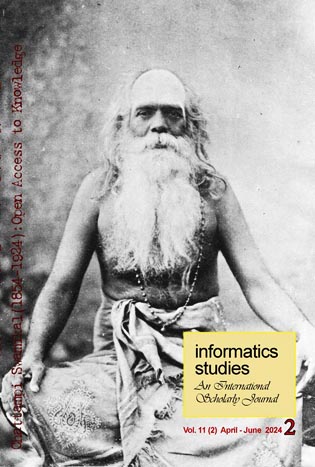
Chattampi Swamikal: The Schoalr Saint Integrating Knowledge and Spirituality in Social and Political Process
Keywords:
History, Biography, India, Kerala, Renaissance, Knowledge managment, Education, Women Empowerment, Advaitha, Social Equality, Human RightsAbstract
Chattampi Swamikal hailed from an impoverished background, where meeting basic necessities like food and education remained hard. Learning to read and write from neighbouring school-going children and acquired knowledge standing outside the classrooms he couldn't enter and eventually enrolled in a free school. Juggling odd jobs like head-load worker, accountant, and a clerk; to support his family, he endured the hardships inflicted by societal inequalities. His wanderings led him to esteemed educational hubs in South India, where he blossomed into a revered scholar and leader, catalyzing Kerala's renaissance. He vehemently opposed casteism, gender oppression, and class hierarchy, advocating for marginalized communities' rights across various spheres. Stressing open access to knowledge resources, self-realization and religious unity, he championed women's education and empowerment, drawing from ancient Indian precedents. A mentor to prominent social reformers, like Narayana Guru his legacy still fuels movements for justice and equality, resonating with contemporary aspirations for a harmonious, egalitarian society. This paper aims to offer a comprehensive overview of his life and contributions.
References
Bhaskara Pilla, Kurumulathu. (2011). Introductory Article in Jeevakarunaya Nirupanam.Kollam, VSK.
Brahmavritha, Swami. (1971. Vagabadanandha Gurudevan. Kottayam, SPCS. Page 40.
Chattampi Swamikal. (1904). Prapanchathil Sthree Purushanmarkkulla Sthanam. Talk at Sthree Samajam, Ernakulam.
Chinmayananda, Swami. (1967). Secret Initiation. Remembrance of Chattampi Swamikal in. K P Karunakara Menon. CS The Great Scholar Saint of Kerala. PGNP. 1967.
Gopala Pillai, Paravoor K. (1935). Parama Bhattara Chattampi Swamikal Tiruvatikal. Trichur, Ramanuja Mudranalayam
Karunakara Menon, K P. (1967). Chattampi Swamikal: The Great Scholar Saint of Kerala.Trivandrum PG Narayana Pillai.
Korath, V M. (1963). Vivekanandha Swamikal Keralathil. In Vivekanandha Sathaka Prasakthi. Thrissur, Sree Ramakrishnasramam.
Kumbalathu Sanku Pillai. (1968). Ente Kazhinjakalasmaranakal. Kottayam, SPCS, 1968
Maheswaran Nair. (1995). Chattampi Swami: Jevithavum Krithikalum (Malayalam).
Marie Louise Burke. Ed. (1978). Life of Swami Vivekanandha by his Eastern and Western disciples. Calcutta, Advaitha Ashram, 1978.
Nancy Patchen. (1989). The Journey of a Master: Swami Chinmayananda: The Man, the Path, the Teaching. Asian Humanities Press.
Narayana Moodithaya. (2008). Sree Chattampi Swamikalu (Kannada). Kasaragod, India: Kasaragodu Prakasana.
Nataraja Guru. (1980). Word of the Guru. Cochin, Paico.
Nirmalananda Giri, Swami. (2005). Non-injury: The ultimate Dharma. Kerala Calling, September 2005.
Nitya Chaithanya Yathi. (1980). ‘Preface’ to Chattampi Swami. Nijananda Vilasam. Varkala, Narayana Gurukulam.
Poulose, C. (2002). Advaita Philosophy of Brahmasree Chattampi Swamikal. Kanyakumari, Tamil Nadu: Ayya Vaikunta Nathar Siddhasramam.
Raman Nair, R and Sulochana Devi, L. (2010). Chattampi Swami: An Intellectual Biography. Chattampi Swamikal Archive, Trivandum, Centre for South Indian Studies.
Santhkumari Amma, Kumbalath. (2003). Vidyadhiraja Chattampi Swamikal. Trivandrum, Kerala: Dept of Cultural Publications, Govt of Kerala.
Sulochana Devi L. (2020). Bharathasmskarathil Sthree: Chattampi Swamikalude Prabandha Pachathalathil Oru Padanam. In Chattampi Swamikal: Sthree Purusha Samatvam. Trivandrum, CS Archive.
Suresh Madhav. (2017). Chattampi Swamiyude Vazhi. Panmana, Jaivapadasala.
Unnnikrishnan, M M. (2021). Chattampi Swamikal Padanangal. Kottayam, DCB.
Vivekanandhan. (2009). Vaikkam. Mahaprabhu. Kottayam, NBS.
Downloads
Published
Issue
Section
License
Submission of a manuscript to IS indicates that the work is original, has not been previously published (except as an abstract, lecture, or thesis), and is not under consideration by another journal. By submitting, authors affirm that their manuscript meets the journal’s ethical and editorial standards and that they agree to the terms of copyright and licensing upon acceptance.
Once accepted for publication, authors grant IS the first publication rights to the work. However, authors retain full copyright of their content and remain the legal owners of their intellectual property.
IS provides open access to all published articles six months after the release of the respective volume. Once the embargo period concludes, articles are made freely available under the Creative Commons Attribution (CC BY) License (https://creativecommons.org/licenses/by/4.0/). This license allows users to share, adapt, and reuse the work in any medium or format provided that appropriate credit is given to the original authors and the initial publication in this journal.
The journal's delayed open access model supports global knowledge dissemination, ensuring that research is accessible without financial or legal barriers. Authors are also encouraged to archive their published articles in institutional repositories, personal websites, or other platforms, with full citation of the journal version. Pre-print versions posted online should include a citation and link to the final published version in IS as soon as the issue is available; post-print versions (including the final publisher's PDF) should include a citation and link to the journal's website.
All materials published in the IS website are distributed under a Creative Commons Attribution license, unless otherwise noted.