Democratization of Knowledge, Open Access, Validation, and Rights in Nineteenth Century
Keywords:
Renaissance, Knowledge Management, Information, Open Access, Research Methodology, Democratisation of Knowledge, Vedas, Gender Equality, Alternative Modernity, IndiannessAbstract
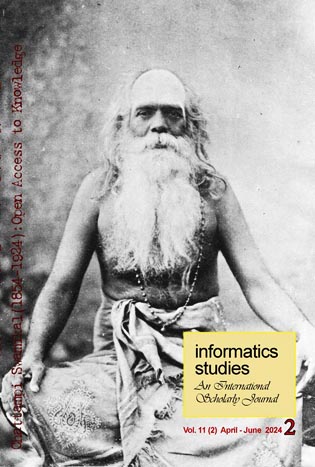
In late 19th century India, renaissance emerged within the colonial-cultural context, leading people to believe that science and technology-based colonial modernity would liberate them from a past filled with myths—a narrative intentionally promoted in regions like Kerala. Admitting this narrative would imply that there were no indigenous efforts against intellectual dominance. However, substantial evidence disproves the notion that Indians were intellectually backward and passively accepted Western modernity. During the renaissance, indigenous thinkers criticized Western dominance and restrictions on knowledge, promoted humanistic philosophy, and contributed to areas such as uplifting the marginalized and gender equality. Figures like Vivekananda and Chattampi Swamikal, who predated Antonio Gramsci's definitions of intellectuals, were far ahead of their time. The West adopted the concepts of Open Access to Knowledge, the right to education and information, and methods to validate knowledge, which Chattampi Swamikal addressed in India during the late nineteenth century, only a hundred years later. Failing to recognize the contributions of these intellectuals shows a lingering blind acceptance of colonial modernity.
References
Chattampi Swamikal (2024). Advaitha System of Thought (English Tr: of Advaitha Chintha Paddhathi Jagathsimhan Nair). Vallikunnam, Vidhyadhiraja International, 2024
Chattampi Swamikal (2024). Compassion: A Critique (English Tr: of Jeevakarunya Nirupanam by Jagathsimhan Nair). Vallikunnam, Vidhyadhiraja International, 2024
Chattampi Swamikal (2024). Right to Learn Vedas: A Critique (English Tr, of Vedadhikara Nirupanam by: Jagathsimhan Nair). Vallikunnam, Vidhyadhiraja International, 2024
Chattampi Swamikal (2024). Role of man and Women in the Cosmic Design (English Tr. Of Prapanchathil Sthreepurushanmarkkulla Sthanam. by Jagathsimhan Nair). Vallikunnam, Vidhyadhiraja International, 2024
Das, AK. 2008. Open Access to Knowledge and Information : Scholarly Literature and Digital Library Initiatives. New Delhi: UNESCO House.
Ganesh, C (2021). Vedadhikara Nirupanam: Reethi Shastravum Aakhyanavum. In: Chattampi Swami Padanangal. Kottayam, DCB, 2021.
Gopala Pilla, N (1953). Vedadhikara Nirupanam: Oru Padanam. Kollam, Shadabda Smaraka Grantham.
Lakshmi Shankar (2024). Sree Vidyaadhiraja Chattampi Swamiyude Vidyavitharana Darshanam. Houston, Santha and Gopinatha Pillai.
Nirmalanandhan, Arumanoor (2008). Vidyadhiraja Chattampi Swamikalude Vedadhikara Nirupanam: Jeevithavum Sameekshayum. Trivandrum, Sahodharan Publications,
Puthusseri, Ramachandran (2011). Thamilakavum Dravida Mahathmyavum. Kollam: Panmana Ashram Pub.
Radhakrishnan, K S (1996). Velichathinu Veli Kettarthu. Mathrubhoomi Azchappathippu, 73(46), 14-20, January, 1996
Rajendra Jinjasu (1990). Forward to Commentary on Vedadhikara Nirupanam of Chattampi Swami by Acharya Narendra Bhooshan. Chengannoor, Nitya Bharathi, 1990
Raman Nair, R (2024). Vedadhikara Nirupanathinte Samuhika Prasakthi. In: Chattampi Swami Padanangal. Kottayam, DCB, 2021.
Sreenathan, M (2023). Chattampi Swamikal: Jnana Navodhana Nayakanaya Jaiva Buddhijeevi. In Unnikrishnan, A M: Chhattambi Swamiyude Jnanalokangal
Sreenathan, M (2024). Chattampi Swamikalude Janana Navodhanam. Trivandrum. State Institute of Languages.
Sulochana Devi, L (1998). Chattampi Swami's Concept of Vedic Authority and Reformation in Kerala. In the Proceedings of the South Indian History Congress. XVIII Session. Kalady, SSUS,
Suresh Madhav. 2011. Thamilakavum Dravida Mahathmyavum. Kollam: Panmana Ashram Pub.
UNESCO. 2024. What is Open Access?. (Online): Available at https://en.unesco.org/open-access/what-open-access
Unnikrishnan, AM (2022). Chattambi Swami Padnangal. Kottayam, DCB.
Unnikrishnan, AM (2023). Chattambi Swamiyude Jnanalokangal. Thalsseri, G V Books.
Vidyanandha Theerthapada Swami (1990). Forward to Vedadhikara Nirupanam. Peruman, Vidyadhiraja.
Vivekanandan, Vaikkom (2007). Vedadhikaram Aarkku? In: Ambaprasadam, August September 2007.
Downloads
Published
Issue
Section
License
Submission of a manuscript to IS indicates that the work is original, has not been previously published (except as an abstract, lecture, or thesis), and is not under consideration by another journal. By submitting, authors affirm that their manuscript meets the journal’s ethical and editorial standards and that they agree to the terms of copyright and licensing upon acceptance.
Once accepted for publication, authors grant IS the first publication rights to the work. However, authors retain full copyright of their content and remain the legal owners of their intellectual property.
IS provides open access to all published articles six months after the release of the respective volume. Once the embargo period concludes, articles are made freely available under the Creative Commons Attribution (CC BY) License (https://creativecommons.org/licenses/by/4.0/). This license allows users to share, adapt, and reuse the work in any medium or format provided that appropriate credit is given to the original authors and the initial publication in this journal.
The journal's delayed open access model supports global knowledge dissemination, ensuring that research is accessible without financial or legal barriers. Authors are also encouraged to archive their published articles in institutional repositories, personal websites, or other platforms, with full citation of the journal version. Pre-print versions posted online should include a citation and link to the final published version in IS as soon as the issue is available; post-print versions (including the final publisher's PDF) should include a citation and link to the journal's website.
All materials published in the IS website are distributed under a Creative Commons Attribution license, unless otherwise noted.