Earliest Attempt on Deconstruction of the Authority to Knowledge
Keywords:
Open Access, India, Information, Vedas, CasteAbstract
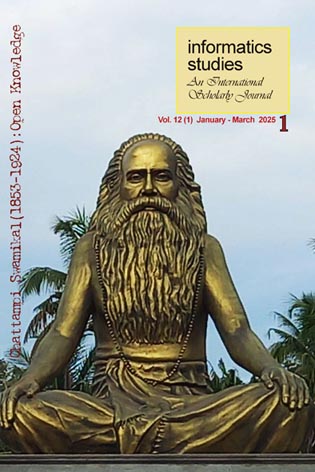
According to Chattampi Swamikal, a minority by monopolizing knowledge control economic resources and political power. To sustain this power, they used caste, religion and related strategies to deny knowledge and education. They misinterpreted religious texts to divide society, restrict the majority's access to knowledge, and prevent them from learning the language used of knowledge transmission. This exclusion kept the majority from gaining social status, economic resources, and political power. Swamikal fought against this monopoly of knowledge by intellectually challenging the distortions in scriptural texts and rejecting the rigid societal divisions based on birth. He opposed all norms that restricted access to knowledge and started a movement to make knowledge available in the common man’s language. This intellectual approach was not a form of modernism imposed by colonialism but an indigenous alternative modernism. It was a blend of modernism, righteousness, and Indian values which Chattampi Swamikal a century ago to fight against colonial domination and social injustices imposed by a powerful minority on the majority. Even in Western academic circles the concept of linking knowledge to power has become widely recognized only in the last two decades through movements like Open Access Initiatives (OAI), Open Science, and Open Knowledge, leading to changes in relevant national and international laws. The paper suggests that the author of the century-old book Vedadhikara Nirupanam, which advocated for Open Access to Knowledge, was remarkably ahead of his time, making his ideas highly relevant in today's society also.
References
Chattampi Swamikal (2024). Right to Learn Vedas: A Critique (English Tr: Jagathsimhan Nair). Vallikunnam, Vidhyadhiraja International, 2024
Chattampi Swamikal. (1920). Vedadhikara Nirupanam, (Translated by Harikrishnan) Ayirur, Sree Vidyadhiraja Gurukulam, 2018.
Ganesh, C (2021). Vedadhikara: Reethi Shastravum Aakhyaanavum. In: Chattampi Swami Padanangal. Kottayam, DCB, 2021.
Gopala Pilla, N (1953). Vedhadhikara Nirupanam: Oru Padanam. Kollam, Shadabda Smaraka Grantham.
Gopinatha Pillai, Vattapparambil (2022). Vedadhikara Nirupanam: Oru Padanam Neyyattinkara, Vidhyadhiraja Vedanta Padana Kendram.
Lakshmishankar (2024). Sree Vidyaadhiraaja Chattampi Swamiyude Vidyavitharana Darshanam. Houston,
Nayar, Acharya E K B. (2021). Vedadhikara Nirupana Padanam. In: Chattampi Swami Padanangal. Kottayam, DCB, 2021.
Nirmalanandhan, Arumanoor (2008). Vidyadhiraja Chattampi Swamikalude Vedhadhikara Nirupanam: Jeevithavum Sameekshayum. Trivandrum, Sahodharan Publications, Radhakrishnan, K S (1996). Velichathinu Veli Kettarthu. Mathrubhoomi Azchappathippu, 73(46), 14-20, January, 1996
Rajendra Jinjasu (1990). Forward to Commentary on Vedadhikara Nirupanam of Chattampi Swami by Acharya Narendra Bhooshan. Chengannoor, Nitya Bharathi, 1990
Raman Nair, R (2024). Vedadhikara Nirupanathinte Samuhika Prasakthi. In: Chattampi Swami Padanangal. Kottayam, DCB, 2021.
Santosh, U P (2021). Arivadhikaravum Aathmajnanavum. CSP
Sashibhushan, M G (1986). Vedhadhikara Nirupanathine Charithra Pradhanyam. Kottayam, Rishiprasadam.
Sreenathan, M (2014). Janadhikara Apanirmithiyum Kerala Navodhanavum. In Chattampi Swamikalude Jnana Navodhanam. Trivandrum. State Institute of Languages 2024 BC VEN
Sreenathan, M (2024). Janadhikara Apanirmithiyum Kerala Navodhanavum. In Chattampi Swamikalude Janana Navodhanam. Trivandrum. State Institute of Languages.
Sreenathan, M (2024). Vedadhikarathinte Malayala Vazhi. Trivandrum. State Institute of Languages.
Sreenathan, M (2024). Vedadhikarathinte Malayla Vazhi. In Chattampi Swamikalude Janana Navodhanam. Trivandrum. State Institute of Languages.
Sreenathan, M (2024). Vedadhikarathinte Malayla Vazhi. In Chattampi Swamikalude Janana Navodhanam. Trivandrum. State Institute of Languages
Sulochana Devi, L (1998). Chattampi Swami's Concept of Vedic Authority and Reformation in Kerala. In the Proceedings of the South Indian History Congress. XVIII Session. Kalady, SSUS,
Ushadevi, N (2021). Vedadhikara Nirupanam : Praveshakam. In: Chattampi Swami Padanangal. Kottayam, DCB, 2021.
Vidyanandha Theerthapada Swami (1990). Forward to Vedadhikara Nirupanam. Peruman, Vidyadhiraja.
Vivekanandan, Vaikkom (20007).Vedadhikaram Aarkku? In: Ambaprasadam, August September 2007.
Downloads
Published
Issue
Section
License
Submission of a manuscript to IS indicates that the work is original, has not been previously published (except as an abstract, lecture, or thesis), and is not under consideration by another journal. By submitting, authors affirm that their manuscript meets the journal’s ethical and editorial standards and that they agree to the terms of copyright and licensing upon acceptance.
Once accepted for publication, authors grant IS the first publication rights to the work. However, authors retain full copyright of their content and remain the legal owners of their intellectual property.
IS provides open access to all published articles six months after the release of the respective volume. Once the embargo period concludes, articles are made freely available under the Creative Commons Attribution (CC BY) License (https://creativecommons.org/licenses/by/4.0/). This license allows users to share, adapt, and reuse the work in any medium or format provided that appropriate credit is given to the original authors and the initial publication in this journal.
The journal's delayed open access model supports global knowledge dissemination, ensuring that research is accessible without financial or legal barriers. Authors are also encouraged to archive their published articles in institutional repositories, personal websites, or other platforms, with full citation of the journal version. Pre-print versions posted online should include a citation and link to the final published version in IS as soon as the issue is available; post-print versions (including the final publisher's PDF) should include a citation and link to the journal's website.
All materials published in the IS website are distributed under a Creative Commons Attribution license, unless otherwise noted.