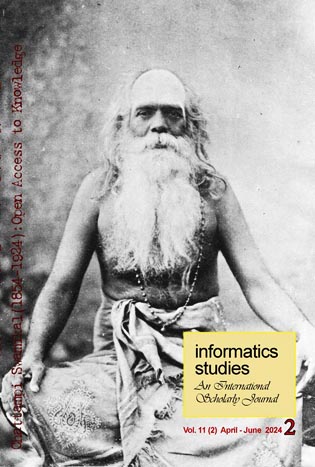
Methodology of Chattampi Swamikal for Refuting the Laws to Monopolise Access to Knowledge
Keywords:
Chattampi Swamikal, eligibility to learn Vedas, privilege to Vedas, Vedas, Vedadhikara Niroopanam, logic, knowledge, testimony, means of knowledge, knowledge science, Hindu scriptures, knowledge systems, knowledge tools, women, learning systems, Shudras,Abstract
The paper analyses the tools and ideas in the book ‘Vedadhikara Niroopanam’ written by Chattampi Swamikal to establish the idea that Knowledge is free and everyone is eligible of its assimilation and dissemination. This also studies the means employed to refute the argument that women and lower class of the society cannot acquire knowledge as of the Vedas. The book has much socio-cultural relevance since it was written in a period when the lower sections of the society were denied education. The paper studies the various arguments put forward by Swamikal like the nature of Vedas, authority of Vedas, review of privilege, other means of proof and counsel of logic. Swamikal quotes various scriptural statements to prove that the prohibition imposed on learning was not supported by the scriptures. He also criticizes the authors and commentators for falsely attributing the meanings to certain statements. He uses Vedic statements along with logical arguments to prove the point. The paper also enquires about the thought process which was used in the verification of various scriptural testimonies. It is also found that Swamikal through his proper scientific way has proved that every human irrespective of his class, caste or gender is eligible to learn Vedas.
References
Chattampi Swamikal, Vedadhikara Niroopanam, English translation by Harikrishnan, Sree Vidyadhiraja Gurukulasramam, Ayiroor, 2018
Sree Vidyananda Theerthapada Swamikal & Ramakrishnan Nair, Sreemath Theerthapada Paramahamsa Swamikal, Theerthapadasramam Vazhoor, Edn.3, 2010
Ulloor S Parameswara Iyer, Kerala Sahitya Charitram, University of Kerala : Dept. of Publication , 1965
Chattampi Swamikal, Nijananda Vilasam, commentary by Nitya Chaitanya Yati
Gavin Flood, An Introduction to Hinduism, Cambridge University Press, ISBN 978-0521438780, page 225
Dictionary of medieval terms and phrases / by Christopher Coredon, ISBN: 1843840235
Downloads
Published
Issue
Section
License
Submission of a manuscript to IS indicates that the work is original, has not been previously published (except as an abstract, lecture, or thesis), and is not under consideration by another journal. By submitting, authors affirm that their manuscript meets the journal’s ethical and editorial standards and that they agree to the terms of copyright and licensing upon acceptance.
Once accepted for publication, authors grant IS the first publication rights to the work. However, authors retain full copyright of their content and remain the legal owners of their intellectual property.
IS provides open access to all published articles six months after the release of the respective volume. Once the embargo period concludes, articles are made freely available under the Creative Commons Attribution (CC BY) License (https://creativecommons.org/licenses/by/4.0/). This license allows users to share, adapt, and reuse the work in any medium or format provided that appropriate credit is given to the original authors and the initial publication in this journal.
The journal's delayed open access model supports global knowledge dissemination, ensuring that research is accessible without financial or legal barriers. Authors are also encouraged to archive their published articles in institutional repositories, personal websites, or other platforms, with full citation of the journal version. Pre-print versions posted online should include a citation and link to the final published version in IS as soon as the issue is available; post-print versions (including the final publisher's PDF) should include a citation and link to the journal's website.
All materials published in the IS website are distributed under a Creative Commons Attribution license, unless otherwise noted.