Open Access Research: A Paradigm Shift in Indian Contexts
Keywords:
Open Access research, Open-access repositories, Global Research, Electronic theses repositories, INFLIBNET, ShodhGanga, ShodhSindhu, Shodh Gangotri, Shodh ShuddhiAbstract
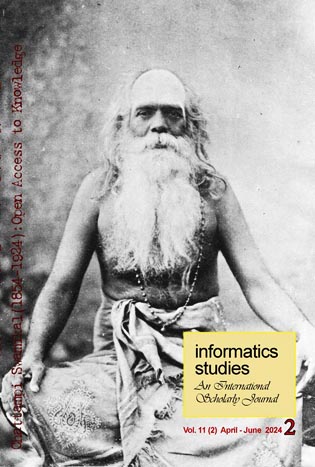
UNESCO's latest science report ranks India as the third most research-intensive country globally, after China. India produces most of the world's open-access research and publishes research in national and international journals. But multinational companies monopolize the results of our research published in their journals or books. this prompted scientists in the West to launch the Open Access Initiatives at the beginning of the 21st century, which is similar to Chattampi Swamikal's efforts in South India. Government or public funding supports most research projects in a country like India. Hence researchers, students, and the general public have every right to access and benefit from the latest research. This only can further strengthen active research and redefinition of acquired knowledge. The country's higher education system is actively regulated and modernized, and now researchers are submitting research reports electronically, which makes Open Access speedy and efficient. Key initiatives include maintaining digital platforms, ensuring seamless access to Indian research, and investing in comprehensive theses collections. This article attempts to look at the current scenario from an Indian perspective.
References
Raman Nair, R., et al., editors. Perspectives on Knowledge Management. K.K. Publications, 2016.
Jancy James, Raman Nair R and Sreekumar G. Doctoral Research at Mahatma Gandhi University: A Bibliometric Analysis. University News, December 22-28, 2009.
Nair, R.R. (2009). Open Access to Knowledge Generated by Research.
Jose. (2016). The movement to bring knowledge produced by PhD research in Indian Universities into Open Access. Perspectives on Knowledge Management. K.K. Publications,
Conroy, G. (2023, July 19). Can India’s new billion-dollar funding agency boost research? Nature News. https://www.nature.com/articles/d41586-023-02336-8
Kuada, J. (2012). Research methodology. Samfundslitteratur.
Katsirikou, A. (Ed.). (2011). Open access to stm information: Trends, models and strategies for libraries. Walter de Gruyter GmbH.
Benefits of Open Access - Cambridge University Press & Assessment. https://www.cambridge.org/core/open-research/open-access/benefits-of-open-access.
Open-access repository - Wikipedia. https://en.wikipedia.org/wiki/Open-access_repository.
Unlocking knowledge: How Open Access initiatives are bridging resource .... https://about.jstor.org/blog/open-access-initiatives/.
Open Data - PLOS. https://plos.org/open-science/open-data/.
en.wikipedia.org. https://en.wikipedia.org/wiki/Open_access.
Varghese, Tomy. “How Open Access Journals Boost Research and Innovation .” From Exclusive to Inclusive: | Career Guru | Manorama Online, 15 Feb. 2024, How Open Access Journals Boost Research and Innovation .” From Exclusive to Inclusive.
Antelman, Kristin. “Do Open-Access Articles Have a Greater Research Impact?” College & Research Libraries, 2004, doi.org/10.5860/CRL.65.5.372.
Gair, S., Zuchowski, I., & Beddoe, L. (2020). Open access publishing: a key enabler to research impact, informed practice and social justice.
McKiernan, E.C., Bourne, P.E., Brown, C.T., Buck, S., Kenall, A., Lin, J., McDougall, D., Nosek, B.A., Ram, K., Soderberg, C.K., Spies, J.R., Thaney, K., Updegrove, A., Woo, K.H., & Yarkoni, T. (2016). How open science helps researchers succeed. eLife, 5.
David, P.A., Bensten, M., & Schroeder, R. (2009). Collaborative Research in e-Science and Open Access to Information.
Miguel, S., Chinchilla-Rodríguez, Z., & Anegón, F.D. (2011). Open access and Scopus: A new approach to scientific visibility from the standpoint of access. J. Assoc. Inf. Sci. Technol., 62, 1130-1145.
Barron, A. (2013). Open access and Creative Commons licensing: copyrights, moral rights and moral panics.
Ramos, J.C. (2018). Las Licencias Creative Commons dentro de la Iniciativa del Acceso Abierto.
Perdue, R.T. (2013). Public Access: For Socially Relevant Knowledge Production and a Democratic Cybersphere.
Belcher, B.M., & Halliwell, J. (2021). Conceptualizing the elements of research impact: towards semantic standards. Humanities and Social Sciences Communications, 8.
INFLIBNET Centre, Gandhinagar. “Inflibnet Centre Gandhinagar.” INFLIBNET Centre Gandhinagar, www.inflibnet.ac.in/. Accessed 20 Feb. 2024.
Shodhganga: a reservoir of Indian theses @ INFLIBNET, https://shodhganga.inflibnet.ac.in:8443/jspui/. Accessed 20 Feb 2024.
Wikipedia, https://ess.inflibnet.ac.in/N-LIST. Accessed 20 Feb. 2024.
Shodhgangotri @ INFLIBNET, https://shodhgangotri.inflibnet.ac.in/. Accessed 20 Feb. 2024.
ShodhShuddhi | Enhancing Research Quality, https://shodhshuddhi.inflibnet.ac.in/. Accessed 20 Feb. 2024.
Willinsky, J.M. (2006). Why Open Access to Research and Scholarship? The Journal of Neuroscience, 26, 9078 - 9079.
Kataria, B.C. (2014). Open access: a revolution in scientific publishing. International Journal of Advances in Medicine, 1, 1-2.
Suber, P. (2012). Open access. MIT Press.
Eve, M. P. (2014). Open access and the humanities: Contexts, controversies and the future. Cambridge: Cambridge University Press.
Rudasill, L. M., & Dorta-Duque, M. E. (Eds.). (2013). Open access and digital libraries: Social science libraries in action. Walter de Gruyter GmbH.
Ekman, R., & Quandt, R. E. (Eds.). (1999). Technology and scholarly communication. University of California Press.
Simons, N., & Richardson, J. (2013). New content in digital repositories: The changing research landscape. Elsevier Science & Technology.
Eden, B. L., & Eden, B. L. (Eds.). (2007). Institutional repositories: International digital library perspectives: institutional repositories. Emerald Publishing Limited.
Downloads
Published
Issue
Section
License
Submission of a manuscript to IS indicates that the work is original, has not been previously published (except as an abstract, lecture, or thesis), and is not under consideration by another journal. By submitting, authors affirm that their manuscript meets the journal’s ethical and editorial standards and that they agree to the terms of copyright and licensing upon acceptance.
Once accepted for publication, authors grant IS the first publication rights to the work. However, authors retain full copyright of their content and remain the legal owners of their intellectual property.
IS provides open access to all published articles six months after the release of the respective volume. Once the embargo period concludes, articles are made freely available under the Creative Commons Attribution (CC BY) License (https://creativecommons.org/licenses/by/4.0/). This license allows users to share, adapt, and reuse the work in any medium or format provided that appropriate credit is given to the original authors and the initial publication in this journal.
The journal's delayed open access model supports global knowledge dissemination, ensuring that research is accessible without financial or legal barriers. Authors are also encouraged to archive their published articles in institutional repositories, personal websites, or other platforms, with full citation of the journal version. Pre-print versions posted online should include a citation and link to the final published version in IS as soon as the issue is available; post-print versions (including the final publisher's PDF) should include a citation and link to the journal's website.
All materials published in the IS website are distributed under a Creative Commons Attribution license, unless otherwise noted.