Seeds of Change: The Enduring Legacy of M.S. Swaminathan in Agriculture
Keywords:
Keywords, Agriculture, Informatics, Food Security, ICT, Science and Technology, Farmers, FishermenAbstract
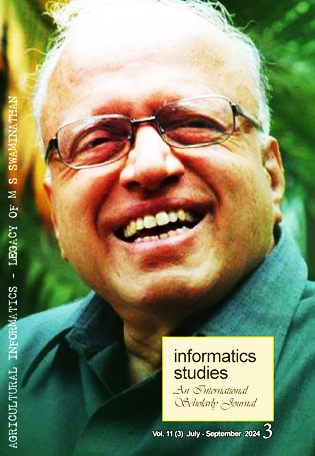
Dr. M. S. Swaminathan made a lasting impact on global agriculture, highlighting the crucial role of science and technology in addressing pressing issues. His dedication to research and development has transformed farming practices and tackled global food security challenges. Through his leadership in academia and international R&D organizations, he played a key role in shaping agricultural policies. He consistently advocated for the needs of smallholder farmers, the conservation of natural resources, and equitable food access. Recognizing the importance of informatics in solving grassroots problems, he stressed the need for technology, community engagement, and traditional knowledge systems to empower marginalized groups. As the world faces growing food security issues and environmental challenges, Dr. Swaminathan’s legacy inspires us to use innovation and compassion to build a more sustainable future. Swaminathan’s tenure as the Director General of the International Rice Research Institute in the Philippines was pivotal and earned him the World Food Prize in 1987, one of agriculture’s most esteemed honors. The United Nations Environment Programme recognized him as the ‘Father of Economic Ecology’ for his leadership in the evergreen revolution in agriculture. In 2024, he was honored with the Bharat Ratna, India’s highest civilian award. Javier Perez de Cuellar, Secretary-General of the United Nations, regarded him as ‘a living legend’ of extraordinary scientific distinction. Dr. M. S. Swaminathan is considered one of the most influential Indians of the last century, following Mahatma Gandhi and Rabindranath Tagore.
References
Quinn, Kenneth M. (1 August 2015). ‘M. S. Swaminathan-Scientist, Hunger Fighter, World Food Prize Laureate’. Current Science. 109 (3)
Rabbinge, Rudy (2015). M. S. Swaminathan: his contributions to science and public policy’. Current Science. 109 (3).
Downloads
Published
Issue
Section
License
Submission of a manuscript to IS indicates that the work is original, has not been previously published (except as an abstract, lecture, or thesis), and is not under consideration by another journal. By submitting, authors affirm that their manuscript meets the journal’s ethical and editorial standards and that they agree to the terms of copyright and licensing upon acceptance.
Once accepted for publication, authors grant IS the first publication rights to the work. However, authors retain full copyright of their content and remain the legal owners of their intellectual property.
IS provides open access to all published articles six months after the release of the respective volume. Once the embargo period concludes, articles are made freely available under the Creative Commons Attribution (CC BY) License (https://creativecommons.org/licenses/by/4.0/). This license allows users to share, adapt, and reuse the work in any medium or format provided that appropriate credit is given to the original authors and the initial publication in this journal.
The journal's delayed open access model supports global knowledge dissemination, ensuring that research is accessible without financial or legal barriers. Authors are also encouraged to archive their published articles in institutional repositories, personal websites, or other platforms, with full citation of the journal version. Pre-print versions posted online should include a citation and link to the final published version in IS as soon as the issue is available; post-print versions (including the final publisher's PDF) should include a citation and link to the journal's website.
All materials published in the IS website are distributed under a Creative Commons Attribution license, unless otherwise noted.