Leveraging Informatics to Conserve Intangible Cultural Heritage of Ayodhya: A Study of Life Events of Lord Rama
Keywords:
Intangible Cultural Heritage, Pilgrimage City, Festivitivals, life event, Ayodya, RamayanaAbstract
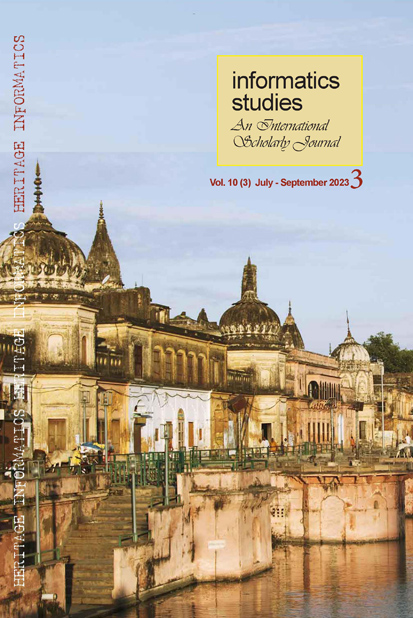
Intangible Cultural Heritage (ICH) is defined by UNESCO as the practices, representations, expressions, knowledge, and skills – as well as the instruments, objects, artefacts, and cultural spaces associated therewith – that communities, groups, and, in some cases, individuals recognize as part of their cultural heritage. ICH is transmitted from generation to generation and is constantly recreated by communities and groups in response to their environment, their interaction with nature, and their history, and it provides them with a sense of identity and continuity, thus promoting respect for cultural diversity and human creativity. According to the UNESCO ICH Convention the intangible cultural heritage, or living heritage, is the mainspring of our cultural diversity, and its maintenance is a guarantee for continuing creativity that is part of a network and interlinking system. The Hindu pilgrimage city Ayodhya is full of intangible cultural heritage and records several festivities and celebrations related to the life events of Lord Rama. Pilgrimage journey based on the life journey of Rama, Ramalila (Rama life story through play), Ramajanmotsava (‘birthday celebration of Rama’), and Ramavivaha (‘marriage celebration of Rama’) are important festivals and celebrations of Ayodhya based on art, culture, and aesthetic sense of intangible cultural heritage. The study explores how Informatics can be harnessed to conserve the ICH of Ayodhya and disseminate knowledge on it to people beyond time and space.
References
Aikawa-Faure, Noriko (2009) From the Proclamation of Masterpieces to the Convention for the Safeguarding of Intangible Cultural Heritage; in, Laurajane Smith and Natsuko Akagawa (eds.) Intangible heritage. Routledge, London, pp. 13-44.
Bandarin, Francisco and van Oers, Ron (2012) The Historic Urban Landscape: Managing heritage in an urban century. Wiley-Blackwell, Chichester.
Idris, Muhammad Zaffwan, & Mustaffa, Norsima & Yusoff, Syed (2016) Preservation of Intangible Cultural Heritage Using Advance Digital Technology: Issues and Challenges. Harmonia: Journal of Arts Research and Education, 16. Doi: https://doi.org/10.15294/harmonia.v16i1.6353.
Kansyakar, Chhedilal (2015) Ramalila ke 500 Varsha: Ayodhya aur Kashi ke Sandarbha mei. Sakshi, vol. 44 (ISSN: 2454-5465). Ayodhya Sodh Samasthan, Ayodhya.
Kumar, Sarvesh and Singh, Rana P.B. (2017) Rationales for inscribing “The Heritage sites, Riverfront and Pilgrimages Routes of Ayodhya” in the UNESCO World Heritage List. Sthapatyam, Indian Journal of Architecture and Allied Sciences (ISSN: 2349-2369, RNI NO. DELBIL/ 2014/56060), vol. 3 (9), November: pp. 51-77.
Kumar, Sarvesh and Singh, Rana P.B. (2019) Ayodhya: A study of Urban Governance and Heritage Inclusive Development; in, Sharma, Vishwa Raj and Chandrakanta (eds.) Making Cities Resilient. The Urban Book Series, ISSN: 2365-757X. Springer Nature Switzerland AG, Cham, and New York: pp. 317-338.
Kumar, Sarvesh (2022) Sacredscapes vis-à-vis Faithscapes: Cultural Landscapes of Ayodhya, a Holy-Heritage City of India; in, Ravi S. Singh, et al. (eds.), Practising Cultural Geographies: Essays in Honour of Rana P.B. Singh. Advances in 21st Century Human Settlements Series (ISSN: 2198-2546). Springer Nature Pte Ltd., Singapore: pp. 111-139.
Roe, Maggie (2017) Landscape and intangible cultural heritage: Interactions, memories, and meanings; in, M. Stefano and P. Davis (eds.) The Routledge companion to intangible cultural heritage. Routledge, London: pp. 317-332.
Sinha, Amita (2006) Landscapes in India: Forms and Meaning. University Press of Colorado, Boulder.
Singh, Rana P.B.; Rana, Pravin S., and Kumar, Sarvesh (2020) Intangible dimensions of urban heritage: Learning from holy cities of India; in, Kapila D. Silva (ed.) The Routledge Handbook on Historic Urban Landscapes of the Asia-Pacific. Routledge, London & New York: DOI, https://doi.org/10.4324/9780429486470_16: pp. 275-293.
Singh, Rana P.B. and Kumar, Sarvesh (2019) Interfacing Cultural Landscapes between India and Korea: Illustrating the Memorial of Korean Queen HEO in Ayodhya. The Geographer (ISSN: 0072-0909 Print, 0975-9522 Online; Aligarh Muslim University Geographical Society, Aligarh, India), vol. 66 (2), July: pp.109- 120.
UNESCO (2003) Convention for the Safeguarding of the Intangible Cultural Heritage. UNESCO, Paris.
Downloads
Published
Issue
Section
License
Submission of a manuscript to IS indicates that the work is original, has not been previously published (except as an abstract, lecture, or thesis), and is not under consideration by another journal. By submitting, authors affirm that their manuscript meets the journal’s ethical and editorial standards and that they agree to the terms of copyright and licensing upon acceptance.
Once accepted for publication, authors grant IS the first publication rights to the work. However, authors retain full copyright of their content and remain the legal owners of their intellectual property.
IS provides open access to all published articles six months after the release of the respective volume. Once the embargo period concludes, articles are made freely available under the Creative Commons Attribution (CC BY) License (https://creativecommons.org/licenses/by/4.0/). This license allows users to share, adapt, and reuse the work in any medium or format provided that appropriate credit is given to the original authors and the initial publication in this journal.
The journal's delayed open access model supports global knowledge dissemination, ensuring that research is accessible without financial or legal barriers. Authors are also encouraged to archive their published articles in institutional repositories, personal websites, or other platforms, with full citation of the journal version. Pre-print versions posted online should include a citation and link to the final published version in IS as soon as the issue is available; post-print versions (including the final publisher's PDF) should include a citation and link to the journal's website.
All materials published in the IS website are distributed under a Creative Commons Attribution license, unless otherwise noted.